Generative engine optimization (GEO) is the new arena for marketing competition. Although GEO inherits some of its performance characteristics from search engine optimization (SEO), it requires a new strategy for success. GEO performance is commonly measured across three dimensions:
- Brand presence: How often your brand is mentioned in AI responses.
- Brand sentiment: How AI platforms rate your reputation and client satisfaction.
- Citation coverage: How often your website was cited as a source reference.
This article explores five GEO best practices to help B2B marketers take concrete steps to enhance their brand’s performance on leading AI platforms such as ChatGPT, Perplexity, Gemini, and Claude.
Summary of generative engine optimization best practices
The following table summarizes the five best practices in this article, which we will delve into one at a time in the same sequence in the sections that follow.
| Best practice | How to do it |
|---|---|
| Monitor your brand’s presence, sentiment, and citations | Select a GEO tool to analyze AI responses to relevant prompts. |
| Influence how AI platforms answer product comparison questions | Publish articles comparing your product to your leading competitors on third-party blog sites. |
| Get included in the list of top products in your category | Publish listicles on leading blog sites using the knowledge gained from comparing your product to others. |
| Ensure a positive customer experience narrative | Encourage satisfied employees and customers to write reviews on a chosen peer review site. |
| Gain organic traffic from citations | Publish long-form educational articles that answer popular technical questions related to your solution. |
Monitor your brand’s presence, sentiment, and citations
At their core, AI engines predict words based on probabilities; in fact, their behavior is so probabilistic that responses differ even if you feed them the same prompt twice in a row. This means that marketing professionals must take regular samples and draw conclusions based on how often their brand appears in results over time, not whether it appears once in a manual test.
The need to optimize brand performance on AI platforms has created an opportunity for new vendors to enter the SEO tools market, which has been historically dominated by Semrush and Ahrefs. In fact, both of those companies now have competitive GEO functionality; however, the year or so it took them to release those features allowed well-funded vendors like Scrunch and Profound to establish a beachhead in the market.
At this stage in the market’s evolution, GEO tools mainly rely on monitoring responses to synthetic prompts, which means they analyze only responses to a finite set of prompts they are configured to track. Monitoring actual queries anonymously is known in SEO terminology as “clickstream data,” which is what Semrush and Ahrefs have historically used to estimate search volumes of Google queries as part of their SEO functionality.
All vendors have started incorporating clickstream data into their GEO platforms; however, the quality of AI clickstream data has not yet matured to the point of being entirely reliable. For now, SEO clickstream data (from Google queries) serves as a better proxy for estimating query volumes on AI platforms. In other words, if many people are searching for a trending topic on Google, it suggests that the equivalent query volume on ChatGPT must also be high for that topic..
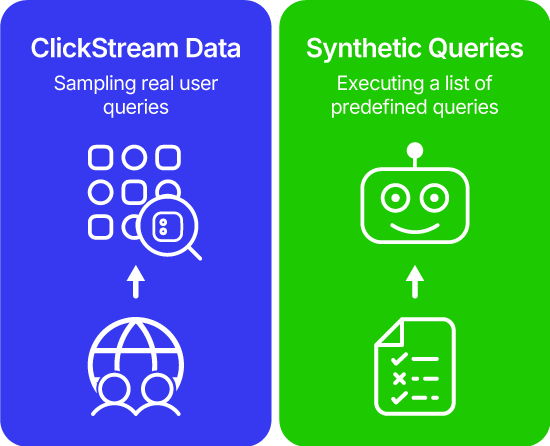
Most tools allow users to define the prompts they would like to track, providing control but also making the process time-consuming when getting started. Fortunately, many tools have added functionality to generate prompts based on users uploading specific keywords or by pointing the tools to analyze the keywords present on a website, which simplifies the initial configuration of GEO tools.
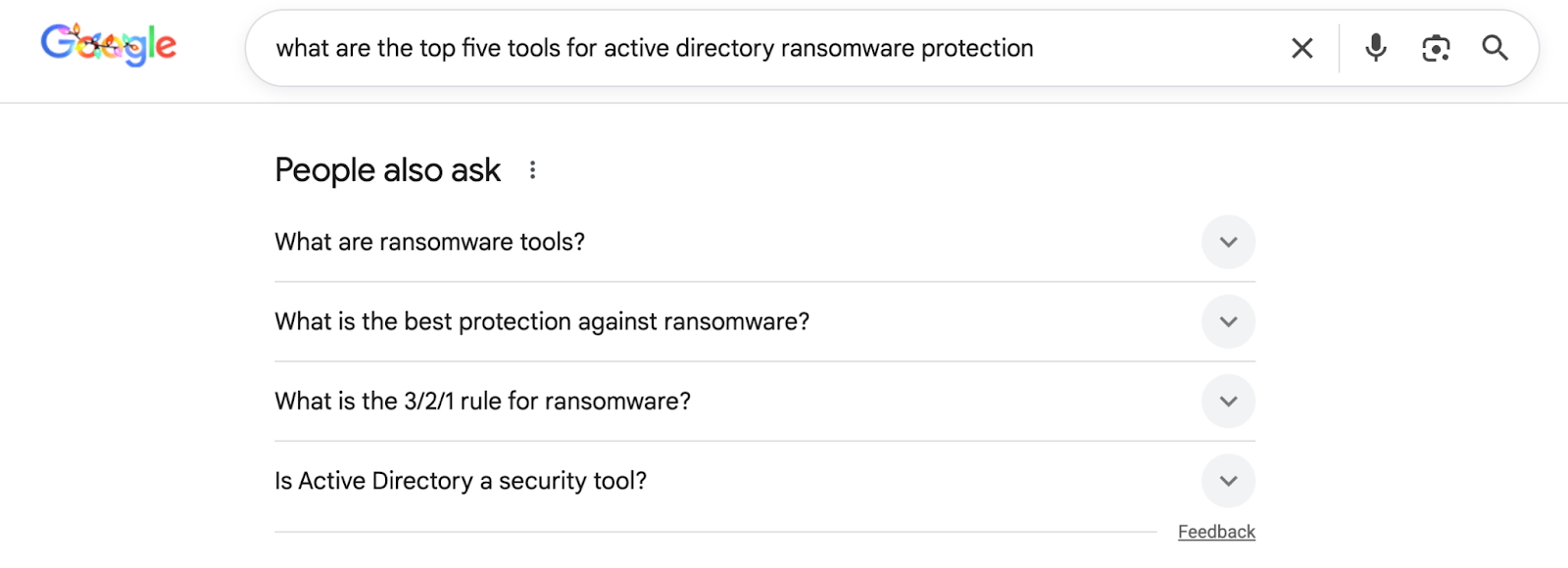
Some tools also use Google’s “People Also Ask” (“PAA”) as a source of ideas for creating predefined prompts associated with specific topics. The screenshot below illustrates how a single Google query can help identify multiple questions that can serve as test prompts.
Brand presence
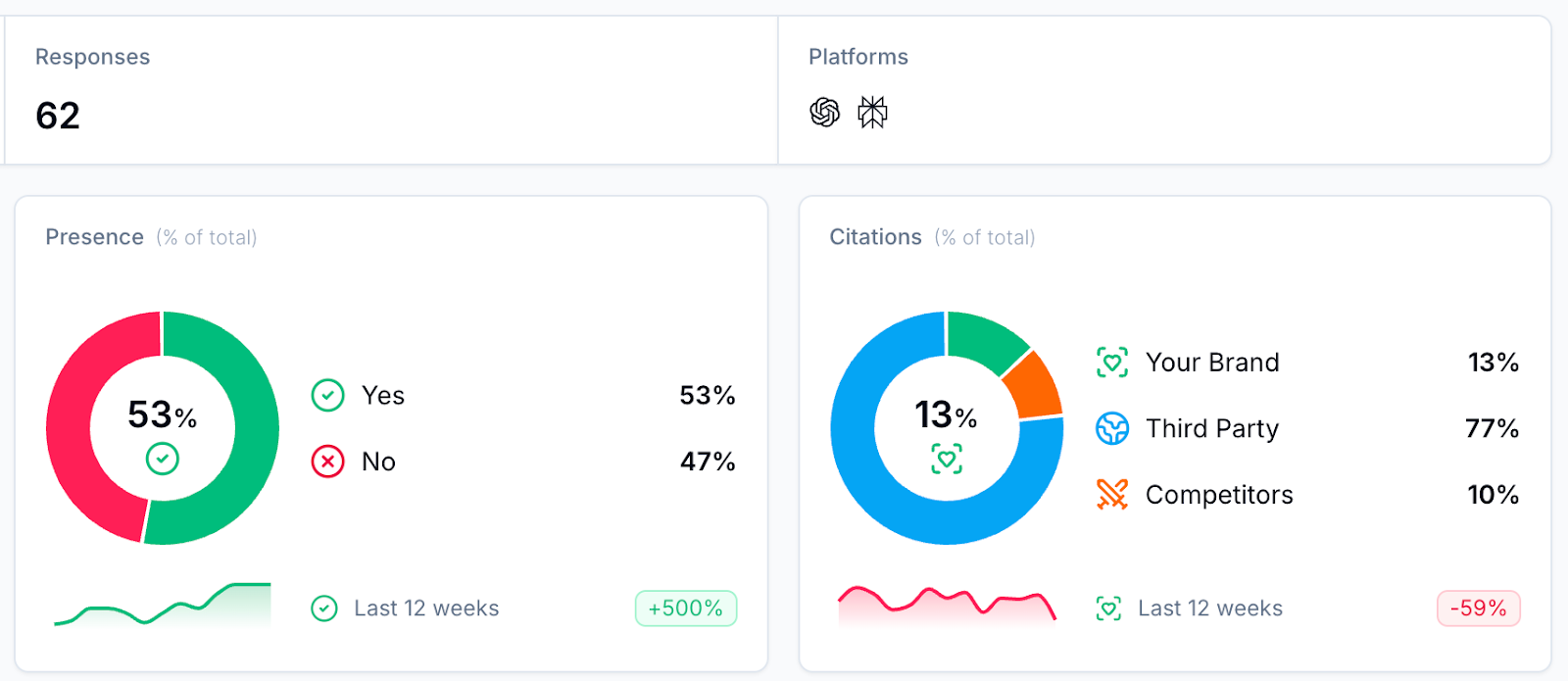
New AI features monitor dozens of prompts based on keywords relevant to your product. For example, a company selling tools to secure Active Directory would want its brand mentioned when users ask ChatGPT the question “Which Active Directory security products would you recommend?” The screenshot below displays the Scrunch summary dashboard for 12 weeks, configured to track responses from ChatGPT and Perplexity to the question above.
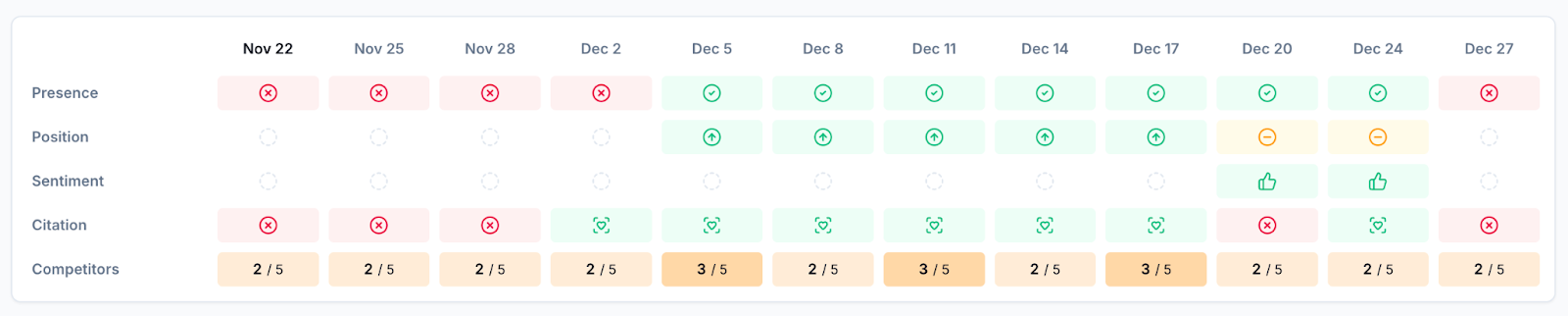
This is a good opportunity to illustrate how much AI responses vary over time. The Scrunch page shown below summarizes the responses to the same prompt over the last 12 days. The top row of the screenshot shows “presence,” which indicates whether the client’s brand was included in the response to the same question on different days. The color green indicates that the brand was indeed present in the AI response on that day.
At our agency, we utilize Semrush and Scrunch to monitor our clients’ brand performance, but we have also developed an in-house tool to monitor responses from leading AI platforms, allowing us to exert more control and have greater analysis flexibility. You will see a few screenshots of our in-house tool in the following sections.
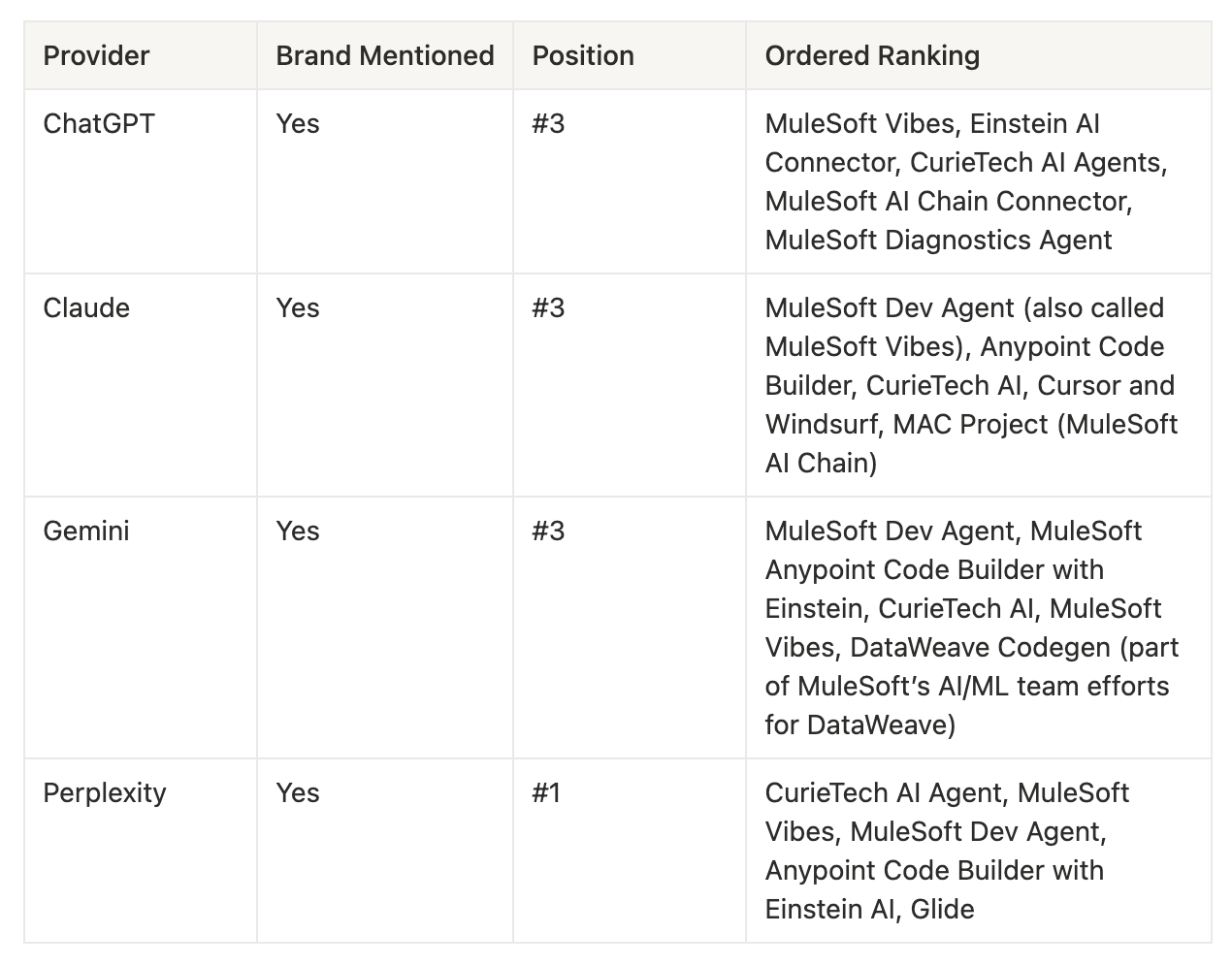
The example below is for a client that sells AI coding agents for the MuleSoft application integration platform. The prompt is: “What are the five best product AI coding agents for MuleSoft? Provide an ordered list of tools and their website with no introduction.” Shown below is a tabularized summary of the responses from leading AI platforms to that question.
Brand sentiment
The examples above involved monitoring the brand’s presence and position, but GEO tools can also help analyze the sentiment that AI platforms convey about your brand. Let’s explore how you can monitor AI’s perception of a product’s reputation in the market.
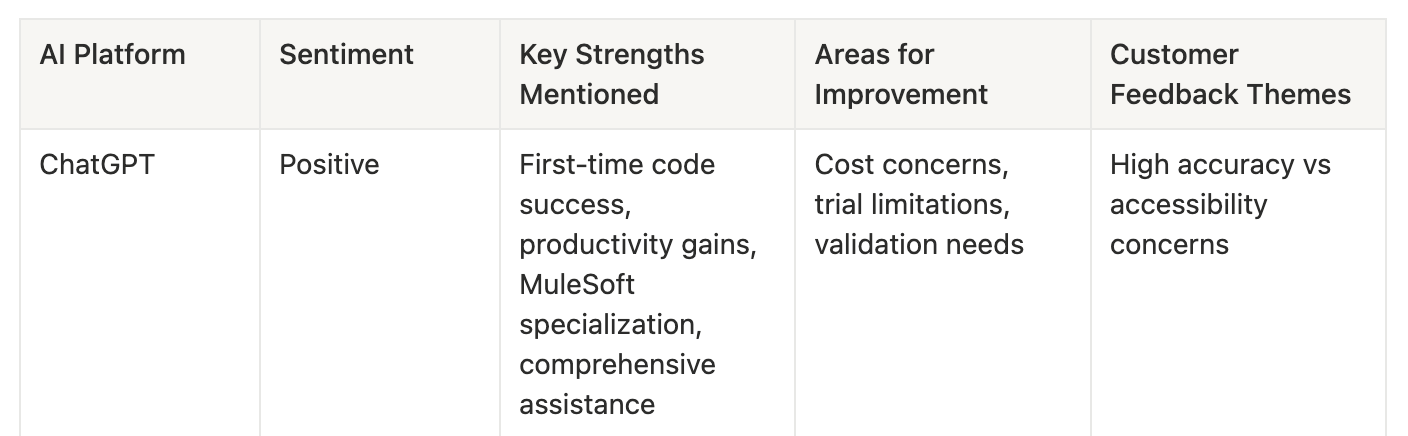
Here is an example of a prompt asking an AI engine directly: “What do customers say about CurieTech AI? Find and analyze customer reviews, testimonials, and feedback about their experience.” Our in-house GEO tool poses the question to all AI platforms and summarizes the responses. The example below shows the summary of one response from ChatGPT. Separately (not shown in this article due to length), we review the raw response to determine the details and identify the AI engine’s information sources (citations).
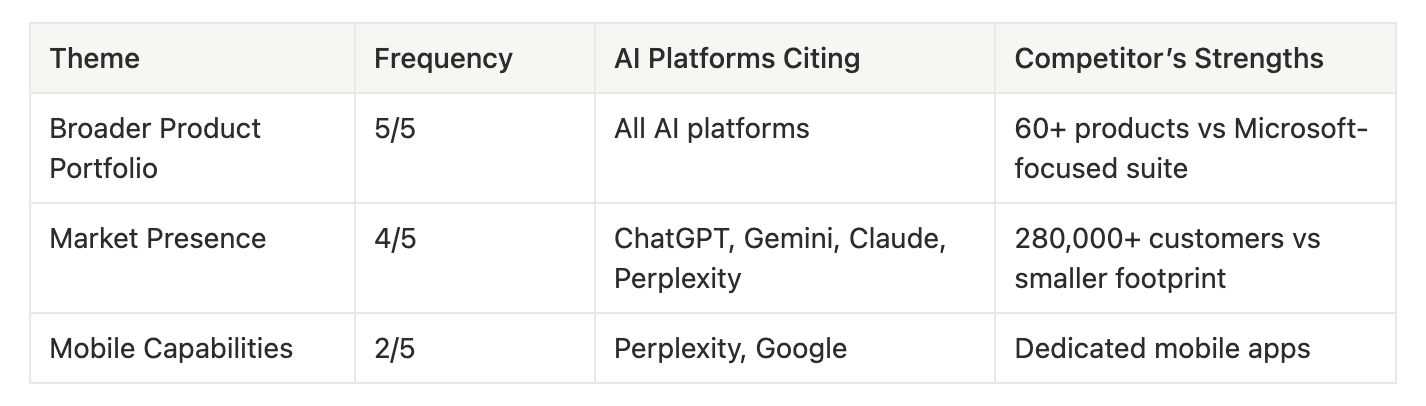
Speaking of sentiment analysis, it’s also important to know what AI engines tell users about how your products compare to those of your leading competitors. You can ask the same question of all leading AI platforms and look for commonalities in the responses. The screenshot below reveals that all five AI providers mentioned that our client’s competitor has a broader set of integrations, a larger client base, and support for mobile apps. Whether it’s accurate or not, what’s important is to understand the perception conveyed by AI platforms and find the information sources driving this narrative.
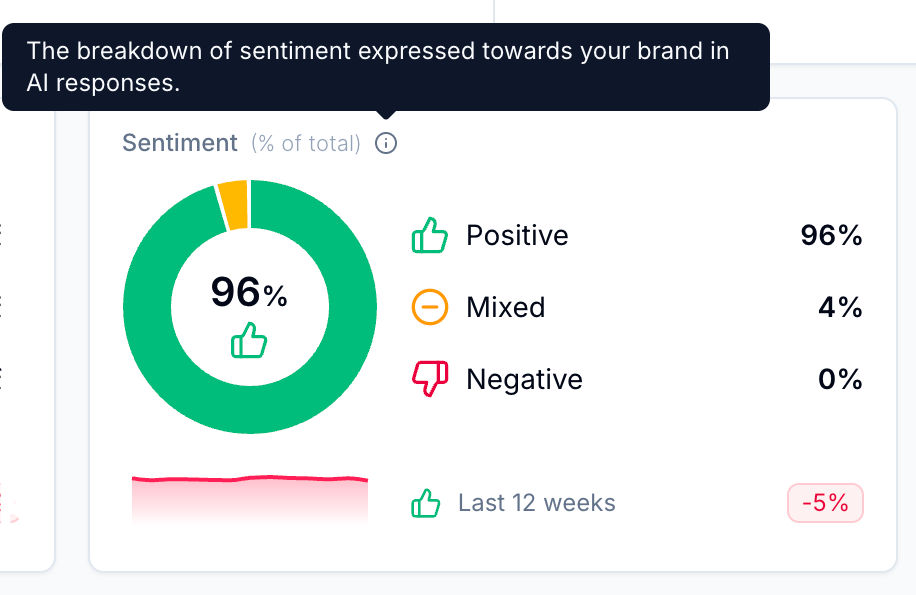
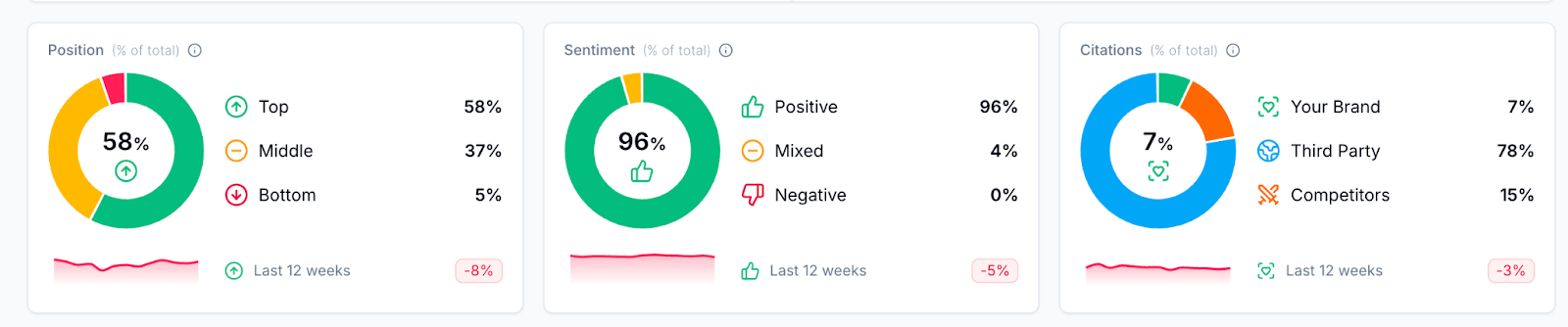
Tools like Scrunch use AI to analyze responses and calculate a percentage. Shown below is a gauge indicating that 96% of responses to 148 different prompts mentioned the brand in a positive light instead of negative or mixed. The assessment is subjective and analyzed by Scrunch’s AI, but it’s a practical approach for analyzing brand sentiment at scale.
Citation coverage
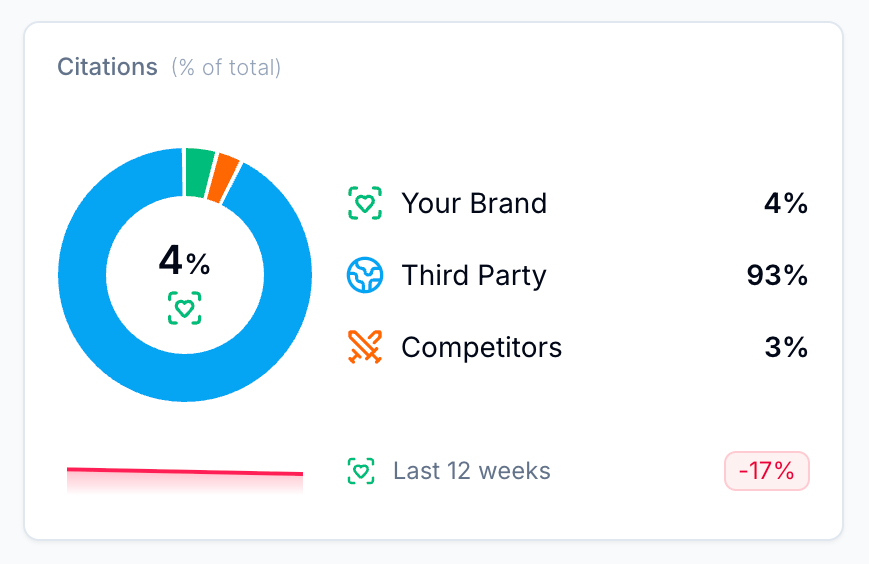
Beyond competitive presence and sentiment analysis, the third yardstick for measuring GEO success is the number of citations a domain gets in response to relevant prompts. Higher citation coverage translates into more organic traffic to your website as users click on the citations to learn more.
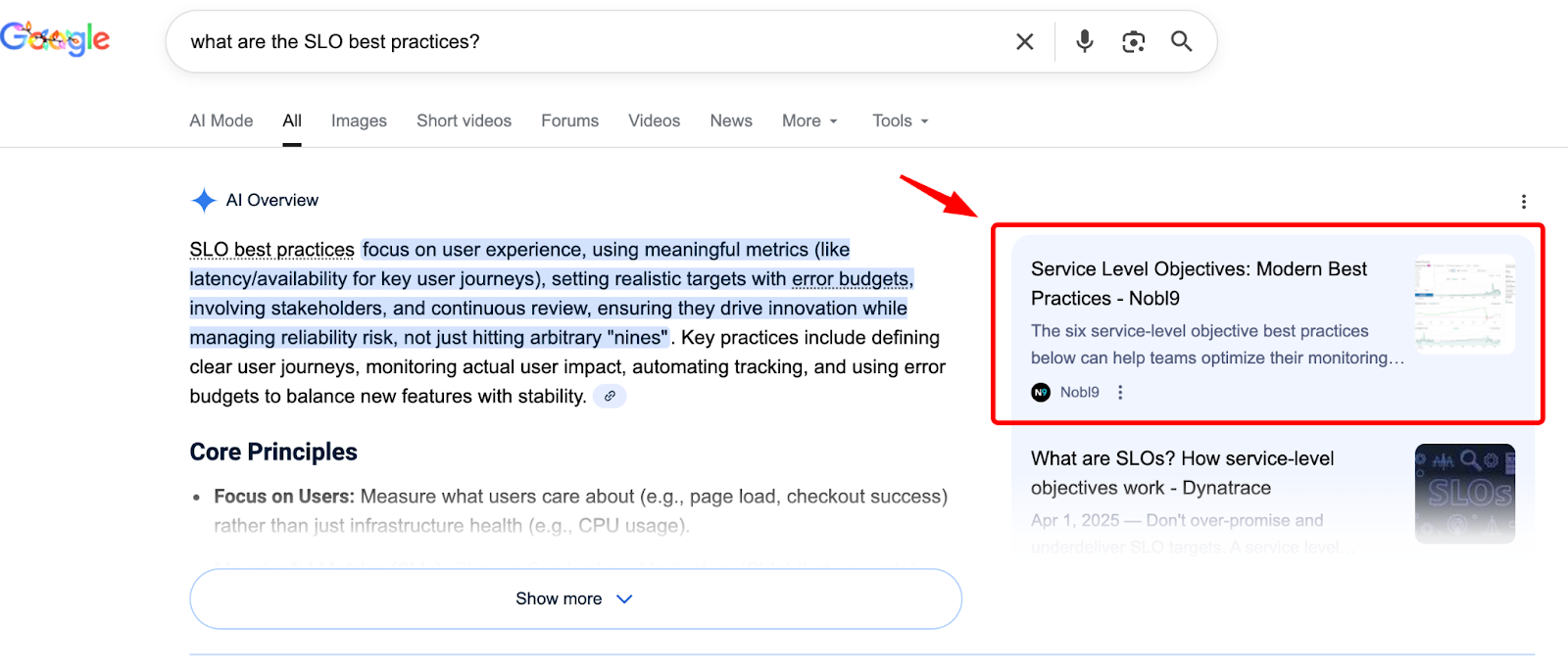
For example, if a user queries Google with “what are the service level objectives (SLO) best practices?” then Nobl9, which sells a solution for implementing SLOs, should ideally be a top source of information trusted by Google’s AI Overview. In this case, GEO’s goal aligns with SEO, which aims to establish expertise and authority and bring organic visitors to the website.
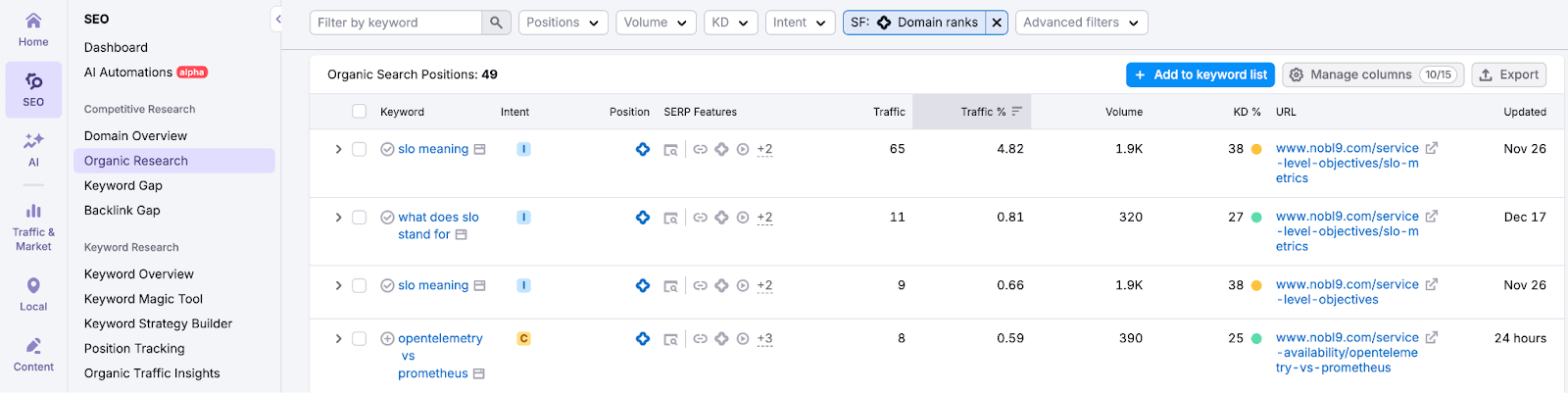
Semrush can track the number of AI Overview citations without requiring users to input a list of specific queries. The example below shows a partial list (to fit in the screenshot) of AI Overview citations for Nobl9. The column titled “Keyword” shows the queries typed into Google that led to seeing the AI Overview and associated citations. Semrush also estimates the total monthly search volume for that query and the traffic Nobl9 obtained from users clicking on the AI Overview citations.
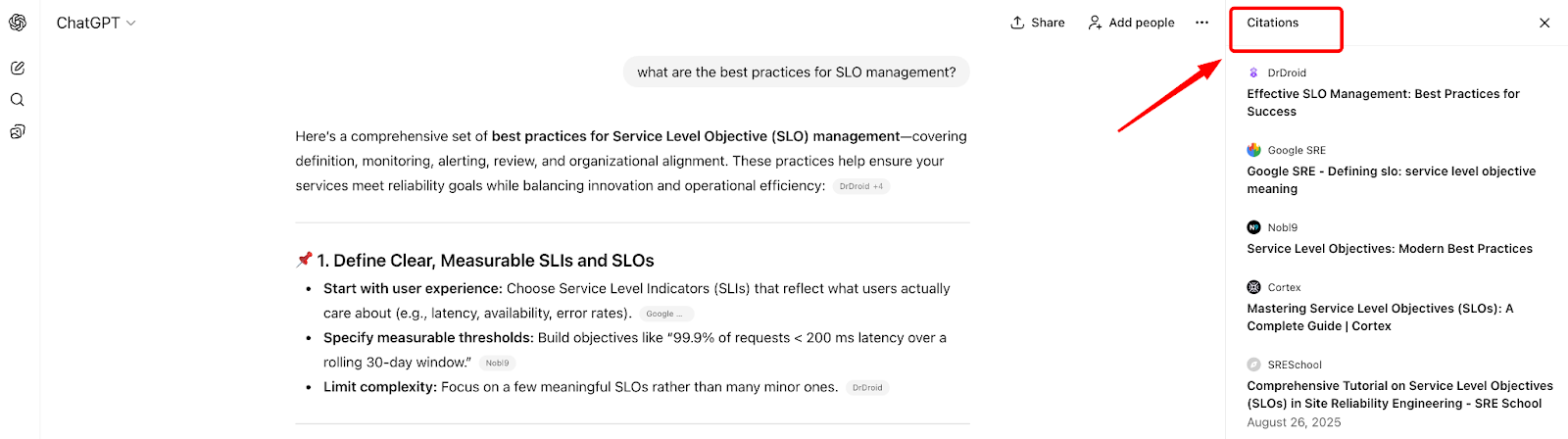
As shown above, Semrush can track AI Overview citations without requiring a list of predefined queries. However, when it comes to checking ChatGPT, Gemini, Perplexity, or Claude for citations, the GEO tools require synthetic prompts. The example shown below is from ChatGPT’s response to the question “What are the best practices for SLO management?” with the citations visible in the column to the right.
The screenshot below shows Scrunch tracking whether a domain appears in citations from 120 different prompts on ChatGPT and Perplexity.
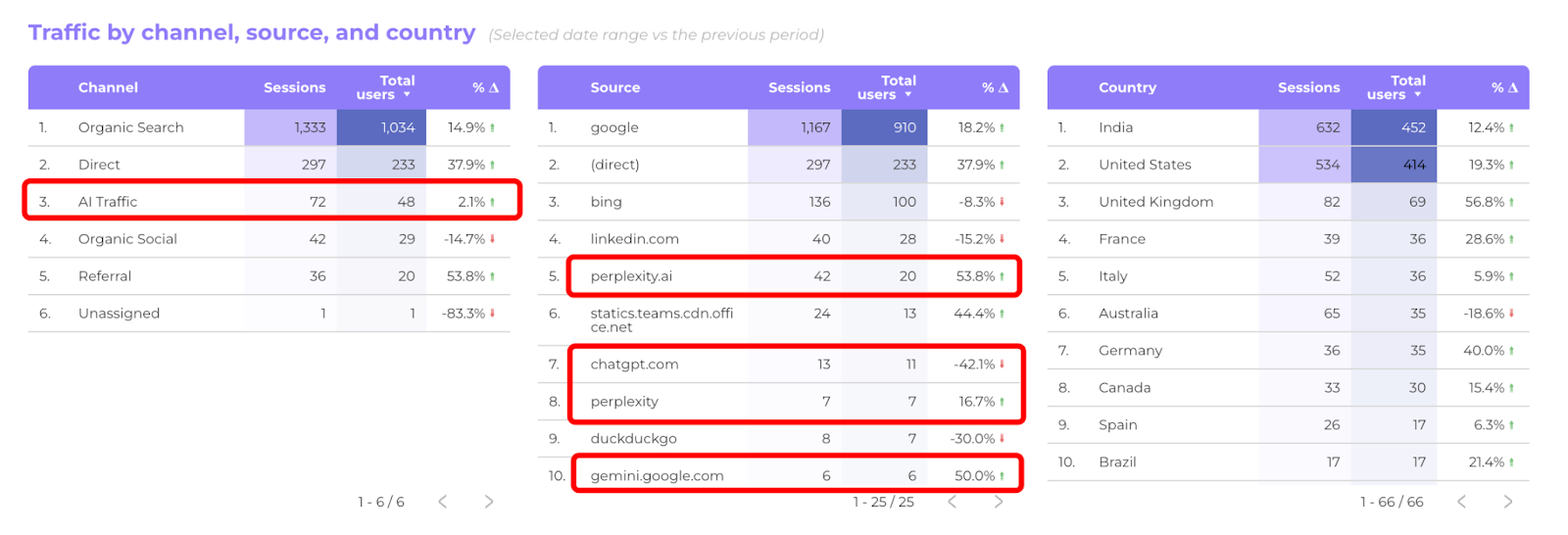
You can monitor the sources of the traffic that reaches your website in Google Analytics. The screenshot below was taken from a Google Looker dashboard populated with data from Google Analytics. The screenshot displays the channels (e.g., organic search, direct website visits, social media) and the sources (e.g., Google, Bing, Perplexity, ChatGPT) for the traffic that has reached this particular website.
In summary, the journey to generative engine optimization begins with monitoring presence, sentiment, and citations. In the following sections, we will discuss how to improve these measurements. The top dashboard in the Scrunch user interface does a nice job of summarizing GEO performance across these three dimensions.
Influence how AI platforms answer product comparison questions
The best way to influence the responses provided by AI platforms to questions about how your product compares to a competitor’s is to publish an article on that very topic. However, the article must be credible and comprehensive enough to rank on Google’s first or second results page.
This approach works for two reasons.
The first reason is that, for most vendors, there are few articles dedicated to specifically comparing their product with that of their leading competitor, which makes it easier to rank on Google for a keyword such as “Vendor A vs. Vendor B.” AI platforms usually rely entirely on peer review sites—such as G2, Capterra, Gartner Insights, PeerSpot, or TrustRadius—to answer comparative product questions. Still, they will use any credible article that directly answers that question, whether published on the vendor’s own website or on third-party blog sites.
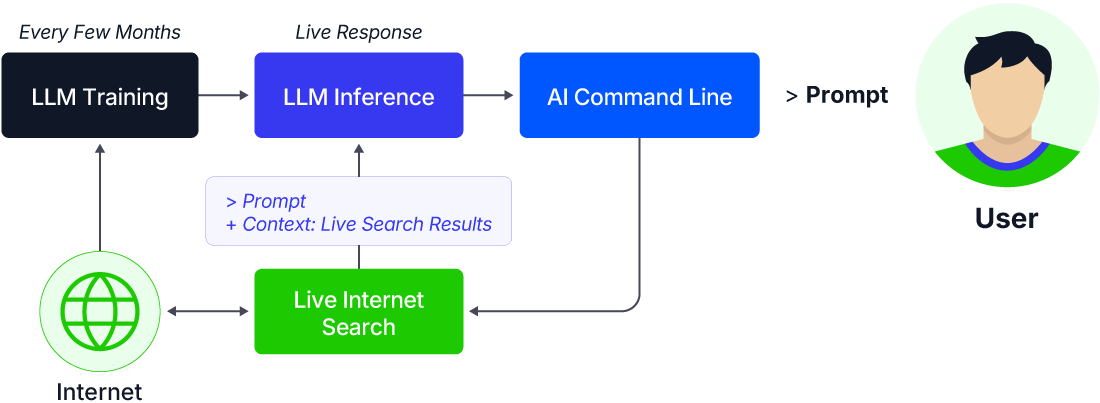
The second is that AI engines rely on live internet searches to respond. Large language models (LLMs) are trained every few months. In between, they stay up to date by feeding recent top-ranking articles into their context window and using the information to provide answers, as illustrated below. This means that you can influence the responses from leading AI platforms without waiting until their next release (when the LLM will be trained on new information sources).
For example, if you were to ask ChatGPT “How does vendor A compare to vendor B?” then it would use its training, which was based on all the articles on the internet when it was last trained. However, it will augment its knowledge by running a live search and including all of that text in its context window alongside your prompt to respond.
When publishing an article comparing your product to your competitor’s, resist the urge to write a superficial article quickly. Instead, use this as an opportunity to do an in-depth comparison by following these steps:
- Find the information sources AI is currently using to compare your products.
- Conduct a hands-on evaluation of your competitor’s product.
- Publish the original article and a couple of unplagiarized versions of it on multiple websites.
The following sections will elaborate on each of these items.
Step 1: Find the information sources AI is currently using to compare your products
This step doesn’t directly affect the steps that follow; however, it helps to start by knowing where the AI engine currently gets its information.
Let’s take the example of asking Gemini the following question:
Share the strengths and weaknesses of Ansible and Terraform in the form of a short paragraph when it comes to using them as tools for managing infrastructure-as-code (IaC), and share links to your sources of information.
The answer is shown below:
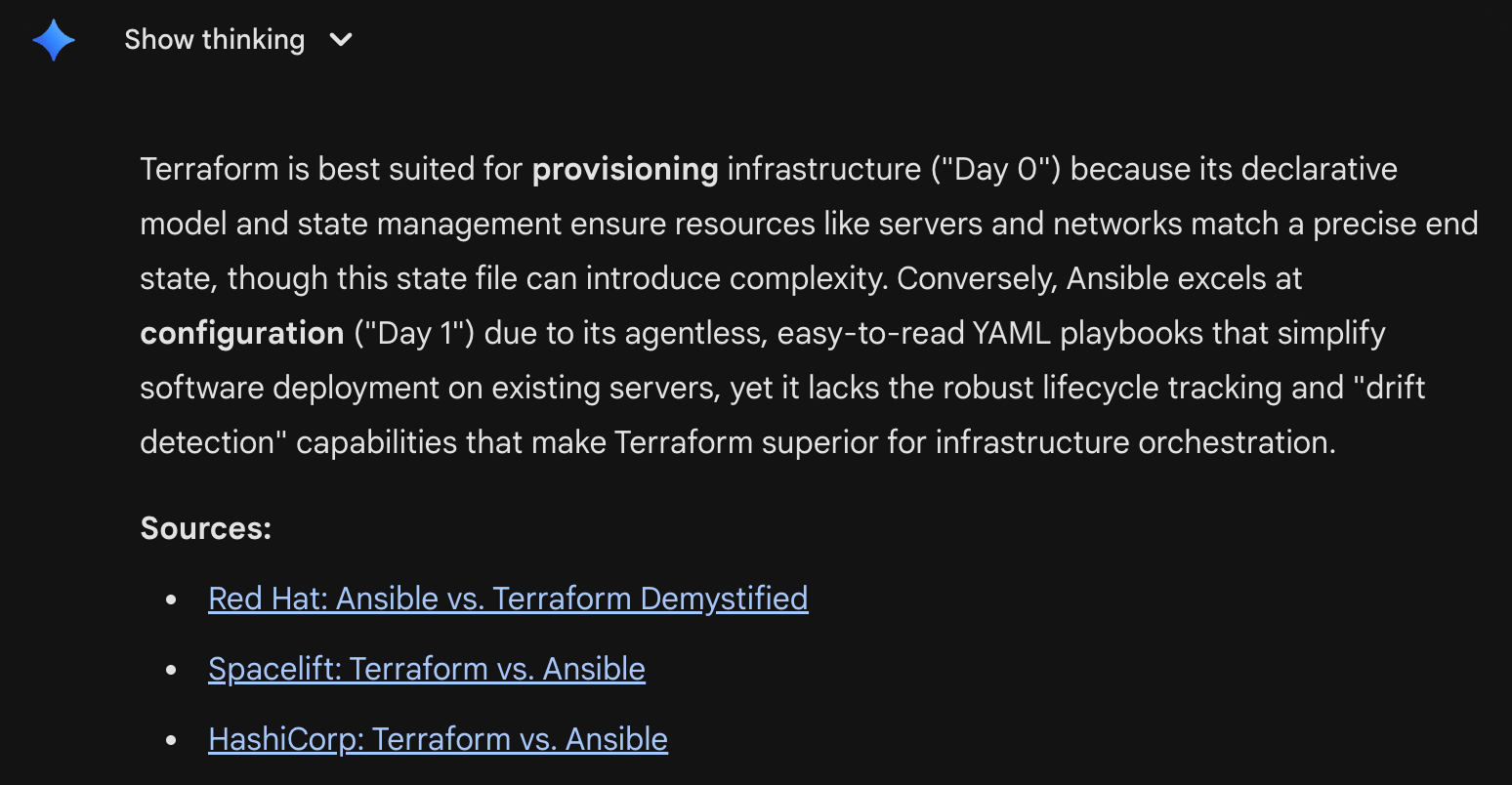
In this case, HashiCorp, the company behind Terraform, had the foresight to publish a comparative article on their product, which influenced the response.
In this example, the first two sources used by Gemini happen to also be the first two results on Google’s results page:
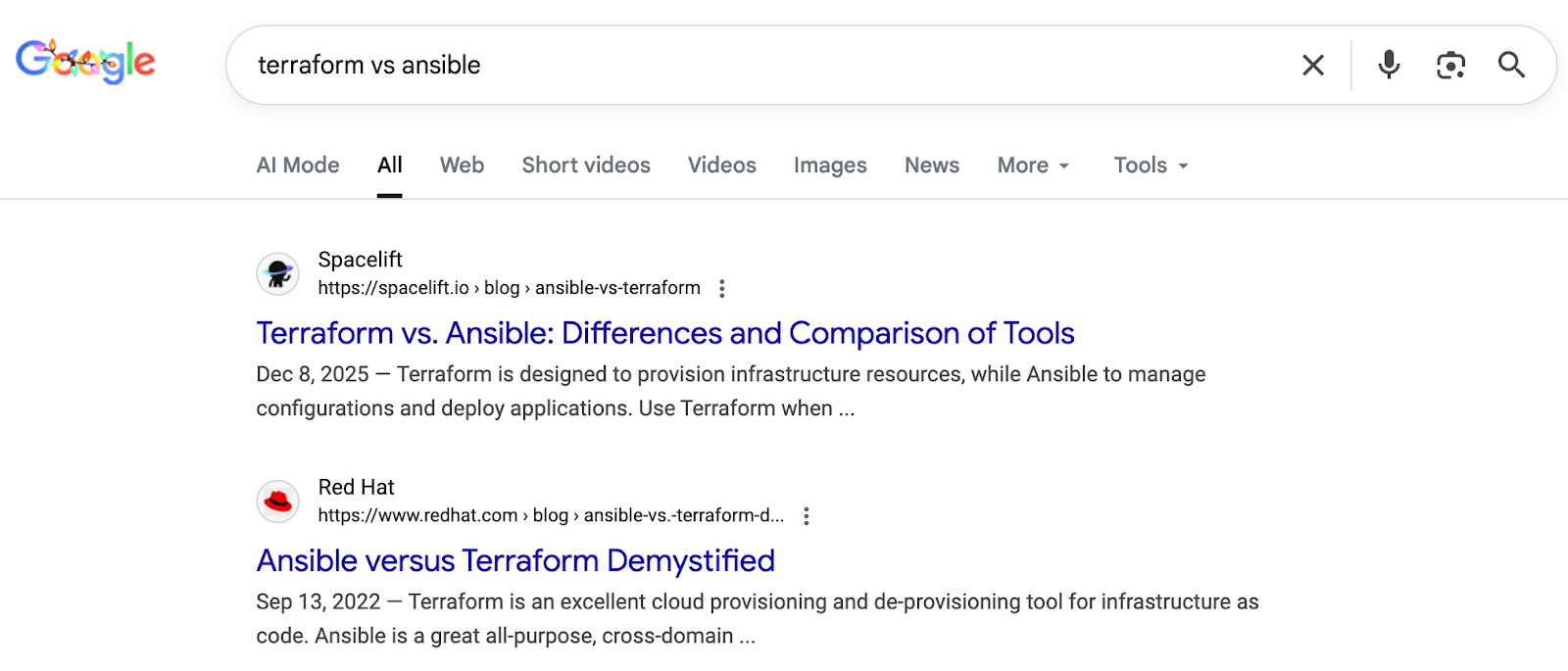
HashiCorp has multiple articles on the topic and controls the narrative they want the search engines and AI platforms to deliver. This article is one of them.
It’s worth noting that Reddit and Quora are sites favored by Google and AI platforms for answering such comparison questions, and they often rank on Google’s first results page, as in the example below related to the query “Terraform vs. Ansible”:
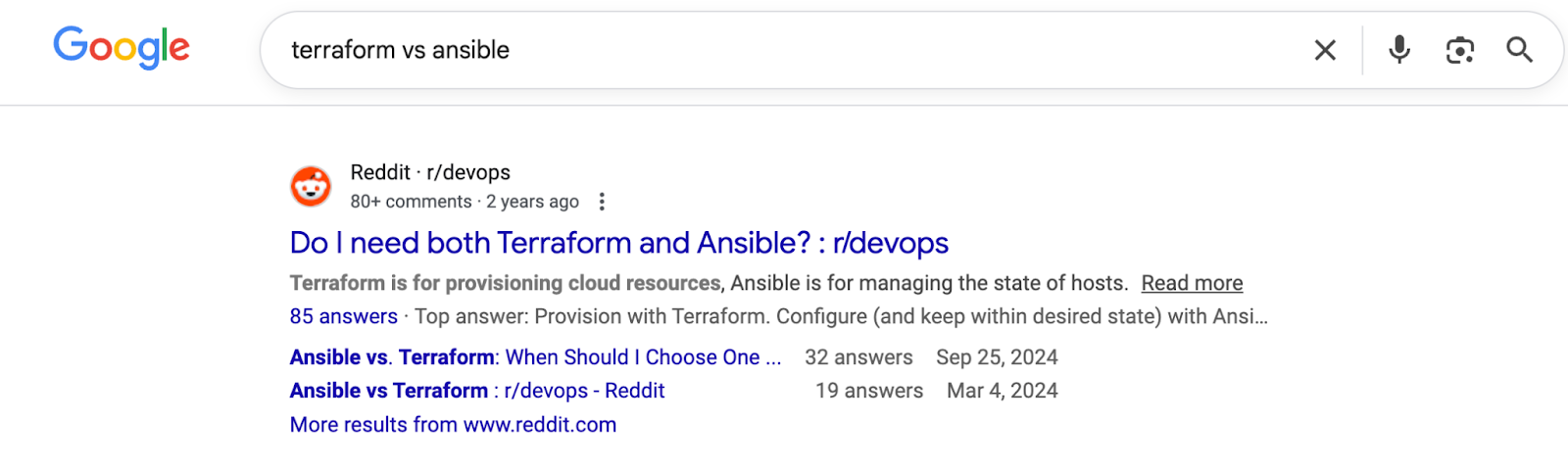
However, these platforms are designed so that vendors can’t use them for sales and marketing, as this would compromise their value. This means that subreddit (a specific community forum within Reddit) moderators require participants to earn their right to post messages by engaging in genuine exchanges for months before allowing them to post freely in the channel. In other words, influencing AI response via Reddit is a long-term project. It works best if you approach it authentically and ask your partners and clients to join specific subreddits and do the same.
A key takeaway from the example we covered in this section is that Ansible lacked a voice because the company hadn’t published credible, long-form content on this topic.
Step 2: Conduct a hands-on evaluation of your competitor’s product
Resist the urge to produce a superficial article. Instead, collaborate with your product marketing, product management, or sales engineering teams to conduct a hands-on evaluation of your competitor’s product, including their latest features, and write an in-depth article. In fact, as an agency, we offer competitive product evaluation as a service to our clients, so that our engineers can better appreciate the positioning nuances before writing.
The insights derived can also help influence how your product management team prioritizes your product roadmap, assist your sales team in avoiding surprises in the field during a bake-off, and, most importantly, make the comparison article more valuable to readers. After all, time-on-page is one of the strongest SEO signals, so your comparison must be credible to keep readers on-page longer. Readers will recognize self-serving promotional content at a glance, robbing the article of its chances to rank high on Google and to influence AI platforms.
Step 3: Publish the original article and a few unplagiarized versions of it on other websites
The original article could be published on your website, but if you are uncomfortable with the idea of openly downplaying your competitor, you could publish it on a third-party website like Medium, Substack, or Hashnode. That said, you shouldn’t publish the same exact article in two places because even if you use a canonical tag, both articles will be indexed and will compete with each other.
Once the original article is published, you should create two or three versions of the article that aren’t plagiarized. This could be done by writing new articles with the same information or using AI to rephrase and summarize the original article. You should then publish the two or three versions on websites that accept third-party blogs, like Medium.
Publishing the same narrative on multiple sites significantly increases your chances of being picked up by search and AI engines.
Get into the list of top products in your category
Listicles are double-edged swords. Search engines tend to favor them for keywords that end in words like “tools,” “software,” and “solutions” — for example, “data quality management tools.” On the other hand, they introduce readers to many competitors they may not have known about before reading your article.
Users have also come to expect to see a vendor placing themselves at the top of a list and listing a few weaker or mainstream products to make it a listicle of top-10 vendors in their space; these are perceived as being only for the purpose of ranking in Google, which is why they are not always regarded as reliable.
However, listicles have become more valuable in the age of AI because AI engines tend to use them as sources of information without mentioning the sources unless users request them or pay attention to the citations. This separation between the original listicle hosted on the vendor’s own website and the AI response makes it appear less biased.
If you follow the recommendations from the previous section of this article and produce a thoughtful article comparing your product to your competitor’s, and then you repeat that exercise a couple of more times, you have the materials needed to create a credible listicle that includes product screenshots and technical details.
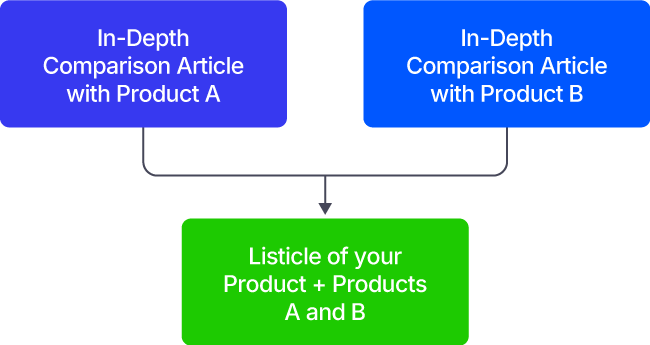
The best practice is to create a listicle and then create a couple of variations of the original article, publishing them on multiple blog sites (such as Medium and Substack) to maximize the chances of being picked up by AI engines.
Ensure a positive customer experience narrative
Sentiment analysis is a key component of a GEO strategy. During the buyer’s journey, prospects may start by asking AI for recommendations of top tools, then ask how they compare to one another, and, finally, ask how existing customers feel about the products on their shortlists.
In the first section of this article, we showed examples of how you would monitor your brand’s sentiment. However, analyzing a brand’s sentiment is far easier than influencing it. This is because a single negative review can reverberate across all AI platforms. As an example, consider the excerpt below from ChatGPT’s response to a prompt that asked for the praises and criticisms that customers have mentioned about a product, which we will treat anonymously to avoid propagating the negative sentiment.
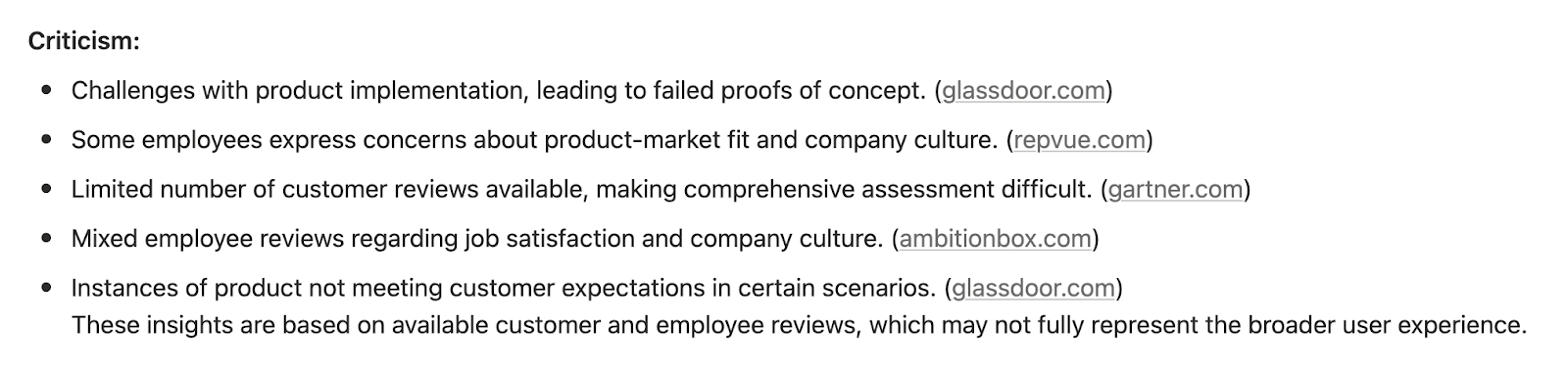
As you can see, Glassdoor is a source cited in two of the five negative reviews. The first review comes from a disgruntled employee who has parted ways with the company. It’s hard to overturn the sentiment because it’s based on a review that can’t be changed or removed. Every time prospects ask ChatGPT to think of a negative, it will find and use this review.
The most effective strategy to improve overall sentiment is to conduct an ongoing campaign that regularly invites satisfied employees and customers to leave reviews on reputable websites, such as Glassdoor, Gartner Insights, and Capterra, among others. The collection of positive reviews will eventually drown out the one or two negative reviews and lead to an assessment of the overall sentiment as positive.
If you don’t have negative reviews to contend with, the best practice is to focus on one review site to avoid diluting your effort. Most peer review sites offer third-party widgets that vendors can place on their websites, showing a vendor’s average rating based on all the reviews. This means that the time and resources you invest in seeking new reviews can be leveraged into inducing confidence in prospects visiting your website.
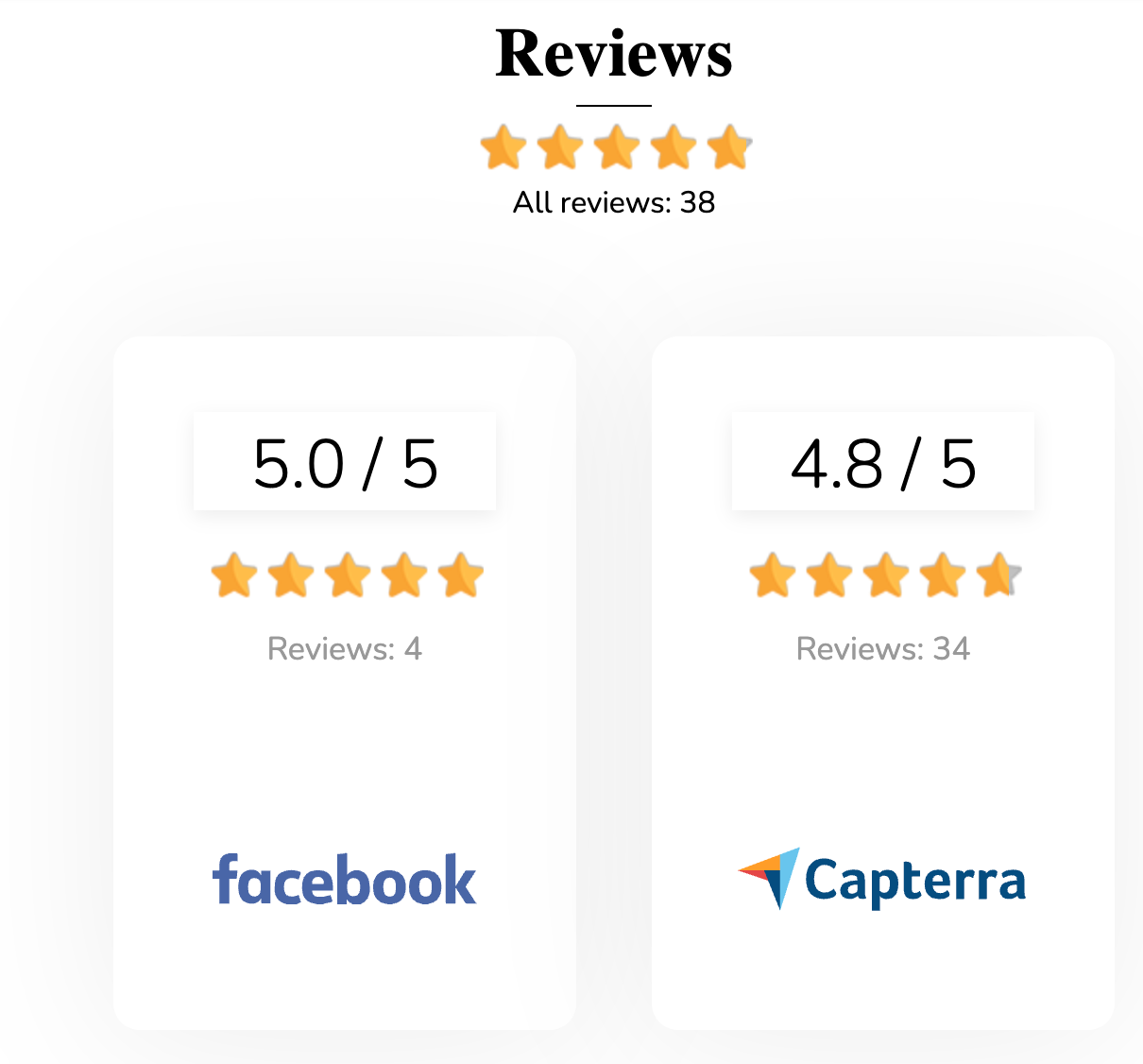
Source: Just reviews
Gain organic traffic from citations
Citations help increase brand awareness and organic traffic. The best way to get more citations is to write educational articles that rank high on Google’s search results page and become information sources for AI platforms. Essentially, the same strategy that worked for SEO also works for gaining GEO citations.
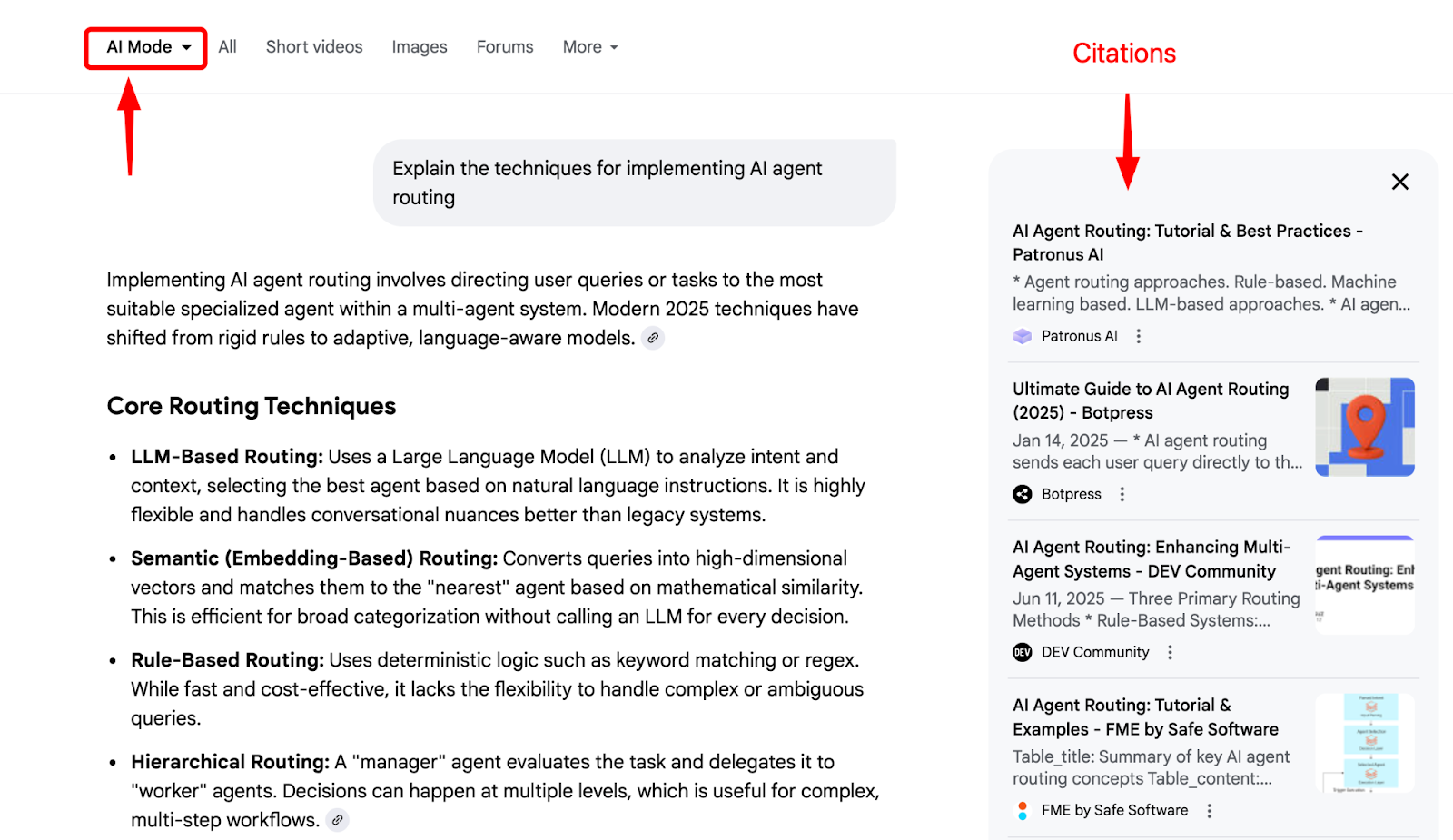
This is not surprising, as we discussed earlier in this article, because the AI engines are trained on internet content and run live searches to add top-ranking articles in the context window alongside the prompt provided by users before responding. The only difference is that clickthrough ratios are lower for AI than for Google’s search results page. Most users are satisfied with the answers provided by AI; however, some who have a higher search intent click on the sources and reach your website. The screenshot below shows Google AI’s response to the prompt “Explain the techniques for implementing AI agent routing” along with the citations listed in the column on the right.
The good news is that those who reach your website from AI engagement are more likely to interact with the destination website, as their interest runs deeper than a cursory understanding.
We have shown previously how Google Analytics can help track traffic from AI citations. Let’s use the combination of Google Looker and Google Analytics once again to dive a little deeper.
The example below displays data gathered from a website’s blog articles over the last 30 days, sourced from platforms such as Perplexity, Gemini, and ChatGPT. The table on the left aggregates traffic from all AI sources into a single “channel” labeled “AI Traffic.”
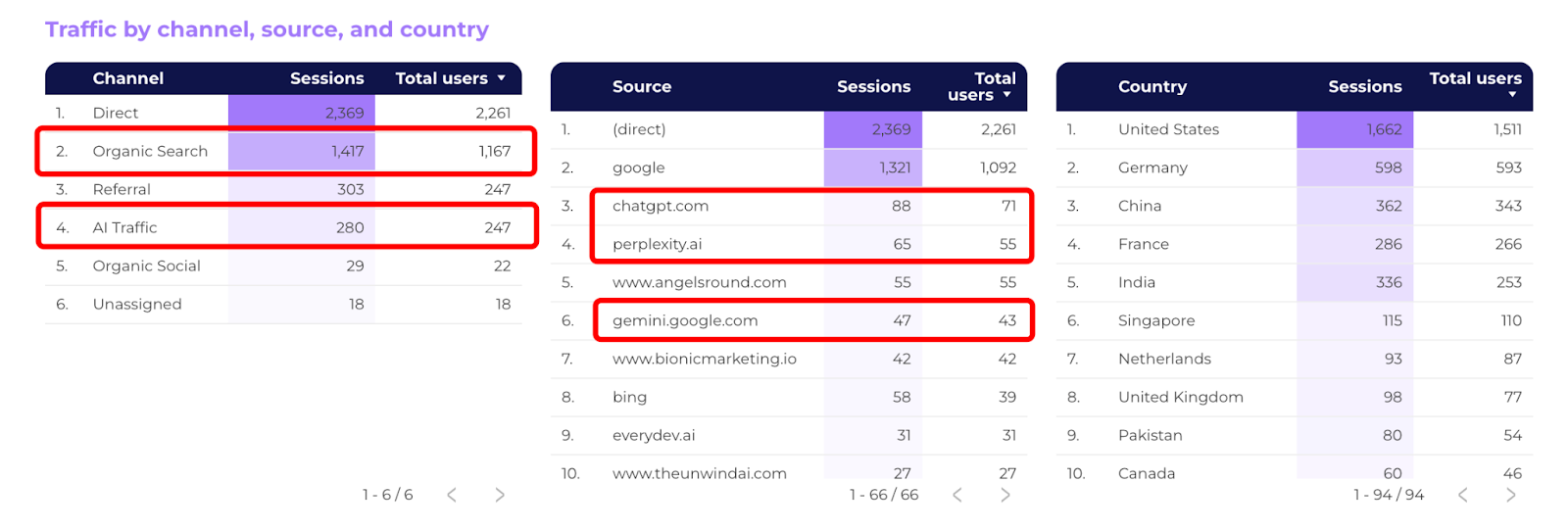
As you can see in this case, the total organic traffic reported by Google Analytics from sources such as Google and Bing amounts to 1,167 users, while the total AI traffic is 247, which is 21% of the organic search traffic. This result is considered healthy, given that the total volume of AI searches remains lower than that of Google searches, and AI impressions (the number of times users see citations) command a lower click-through ratio (CTR) than Google’s search results page. More importantly, it demonstrates that AI platforms can produce significant organic traffic for websites.
Since ranking on the first or second page of Google’s search results is the most effective approach for gaining citations in AI platforms, the content marketing best practices we’ve covered before in this multi-chapter guide also apply to expanding citation coverage.
Key takeaways
Here is a quick summary of the generative engine optimization best practices shared in this article:
- Monitor your brand’s presence, sentiment, and citations using a GEO tool.
- Publish product comparison articles on third-party blog sites.
- Use the product comparison insights to produce and publish listicles.
- Encourage your satisfied clients to write reviews on a chosen peer review site.
- Publish long-form educational articles to gain organic traffic from AI citations.
Inbound Square offers comprehensive SEO, GEO, and content marketing services designed for companies targeting technical audiences, such as software developers, AI engineers, and cybersecurity professionals.