In the early days of answer engine optimization (AEO), the typical strategy advice was to avoid blocking AI bots in robots.txt, use schema markup (metadata used by search and AI crawlers), and add frequently asked questions (FAQ) at the end of your web pages. With some experience, we learned that AI bots aren’t shy about crawling sites—in fact, they visit more often than we want them to. Then, Google clarified that “there’s also no special schema.org structured data that you need to add” to appear in AI answers. And when it comes to FAQs, they help, but not for the reason we imagined. Even though they started as a simplistic attempt to spoon-feed LLMs, they still help by adding depth to pages, which has always helped search engine optimization (SEO).
So, where does this leave you in terms of formulating an AEO strategy that can deliver results?
In this article, we summarize what we have learned from experiments we conducted with more than 30 clients over the course of 18 months. Note that our clients sell enterprise products to technical audiences, so our AEO strategy is mostly relevant to B2B tech companies.
For those who don’t have time to read detailed explanations, here are the key takeaways:
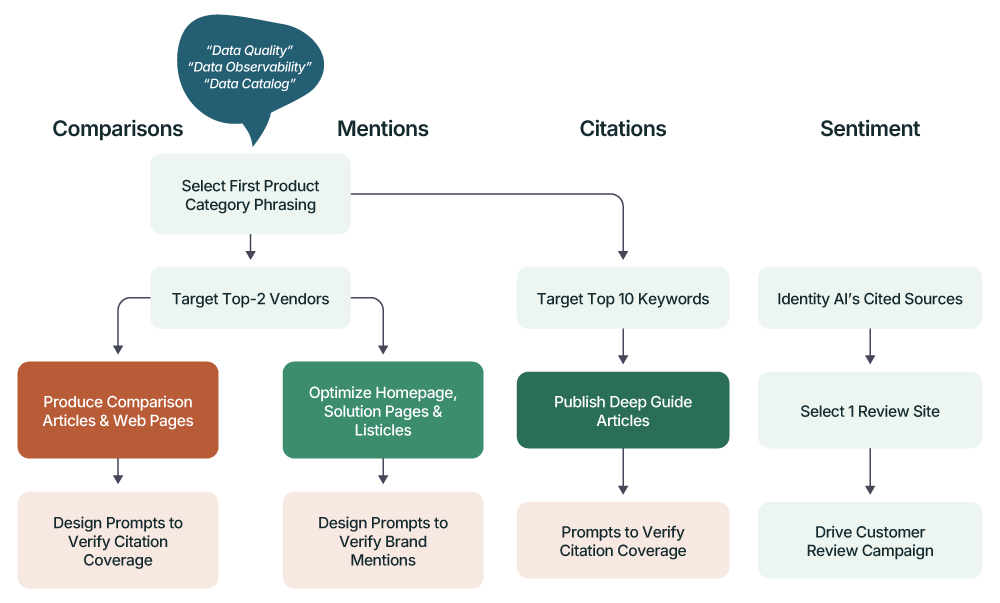
- Use a different strategy for each of the four AEO dimensions: product comparisons, mentions, citations, and sentiment.
- Be precise in your word choice when targeting a product category where you want to increase your share of voice.
- To measure your brand mentions, sentiment, and citation coverage, take the time to write realistic prompts that represent your ideal customer profile.
- Publish authentic human-written content to influence the AI responses and increase your share of voice.
- Measure the impact of your published content with specialized AEO tools such as Profound, as well as native tools such as ChatGPT Business Hub that track real prompts typed by actual users.
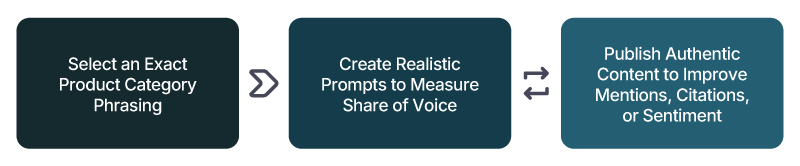
The upshot of our lessons learned is an age-old piece of advice in the tech world of taking lean steps: Prioritize, start small, and measure the results before you scale.
An AEO strategy framework
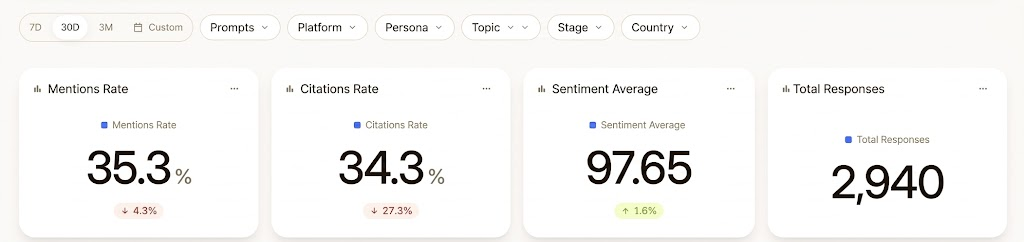
We started like most others, using AEO monitoring tools such as Profound, Peec AI, and Scrunch. We used the tools’ own AI to generate a couple of hundred prompts to measure our clients’ brands’ share of voice. These tools allow you to enter a set of prompts, periodically run them across AI platforms like ChatGPT, Claude, and Gemini, and analyze the responses.
Since AI responses vary each time you ask, these tools are designed to ask questions a few times a week, aggregate the responses, and calculate percentages of mentions or citations over time, as shown in the screenshot below from Scrunch.
We soon learned that the quality of the prompts is more important than their quantity: It’s better to manually type a dozen realistic prompts and add to them over time than to let AI generate a couple of hundred prompts that don’t represent realistic queries that your advanced users might ask.
We also learned that it’s better to categorize the prompts by the dimensions they are intended to measure. In other words, the prompts designed to check for brand mentions must differ in terms of query intent from those meant to measure citations in unbranded AI responses or assess your brand’s market sentiment, as we will cover later in the article.
Measurements are also sensitive to the exact wording of the keyword you use to define your product space. You may have a brand presence of 50% for one phrase that describes your product category but none if you change it by a couple of words.
We created the diagram below to summarize our approach based on the lessons learned. The diagram may not make sense at first glance. We are sharing it as a reference framework or visual summary, with an article section dedicated to explaining each of the four AEO dimensions you see below: comparisons, mentions, citations, and sentiment.
Groundwork: Target a category, map its competition, and align your website
Before digging into the strategies for each of the four AEO dimensions, we will pick a specific product category to ground our explanations in real-world examples.
Let’s use tools enterprises use to manage the quality of data feeding business intelligence applications, which are designed to ensure data accuracy and timeliness. In simple terms, this is a category of data engineering tools that detect delayed, missing, or inaccurate data before data quality problems undermine human decisions or agentic workflows.
With our example category defined, the three steps below lay the groundwork for the strategies we will use for every subsequent AEO dimension: choosing the exact phrasing for your product category, identifying the top vendors you’re competing with for AI visibility, and ensuring your own website uses that phrasing consistently.
1. Start with a specific product category phrasing
AI engines are sensitive to the exact words you use to describe your product’s category. Staying with the example of tools intended to measure the quality of enterprise data, vendors may specialize in slightly different aspects of it or prefer to differentiate their positioning to stand out, but every word choice matters.
The space we are using as an example in this article is traditionally defined as “data quality” management, which has led more vendors to adopt that phrasing. However, some vendors also offer “data observability” functionality, which is closely related to data quality management but distinct from it. Other vendors emphasize their “data catalog” functionality, which is a component required to discover and inventory data sources for subsequent data quality measurements. Even though most vendors offer all three areas of functionality in a single product platform, we must target each term separately.
Selecting the right term depends on your product’s core competencies, the search volume for each keyword, and the competitiveness of each keyword space.
The table below shows the search volumes for each of the terms above in the US at the time of writing this article. Search volumes are also reported by tools like Semrush and Ahrefs, but for this example, we are using data from Google’s tools to plan Google Ads strategies.
| Keyword | Monthly US Search Volume |
|---|---|
| Data catalog | 1600 |
| Data quality | 1300 |
| Data observability | 590 |
2. Identify the top two vendors
At our agency, we’ve developed an in-house tool for the key prompts we monitor closely, even though, as mentioned before, we also use tools such as Profound, Peec AI, or Scrunch for monitoring a high volume of prompts. We built our in-house tool to provide consistency across clients, who may each use a different tool (or none at all).
The screenshot below shows our in-house tool’s summarized report of brand mentions in response to the following prompt:
“What are the 5 best product tools for data quality management? Provide an ordered list of tools and their website with no introduction.”
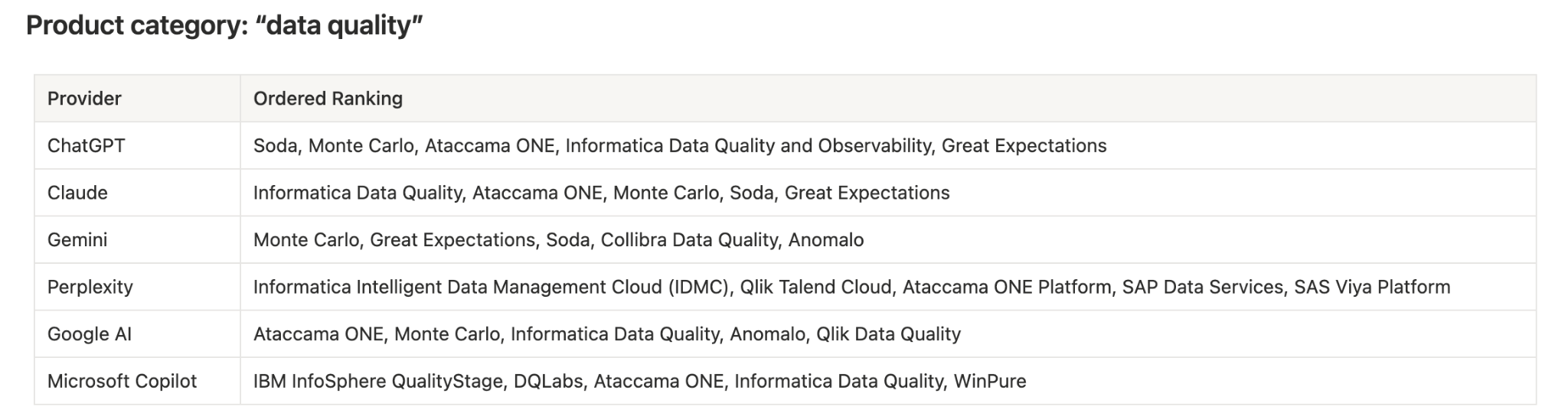
This table shows the results for a snapshot in time only. If we fed the same prompt to AI providers a second time immediately after, we would get slightly different answers, which is why brand presence must be calculated as a percentage over time to be meaningful.
Even so, based on the snapshot response summarized in the table above, which remains statistically significant, Ataccama and Informatica seem to have the most consistent brand presence. Whether our sales team competes with these two vendors in the field or not is a secondary consideration. The important takeaway is that we are competing with them for AEO brand real estate.
3. Ensure that your homepage and solutions pages use the phrasing
The keywords used in your homepage’s H1 and H2 titles are important in that they clarify your market positioning to visitors and algorithms alike, and they also contribute to your website’s topical authority. If you think about it in terms of Google E-E-A-T—experience, expertise, authoritativeness, and trustworthiness—your homepage and core product pages demonstrate your focus areas and subject matter expertise.
As you target multiple keywords over time to attract users interested in the various use cases supported by your product (e.g., data quality, data observability, and data catalog), you should create solution pages for each use case, include the target keywords in the H1 and some of the H2s (without overdoing it), and offer deep, authentic, and genuinely informative content on those pages.
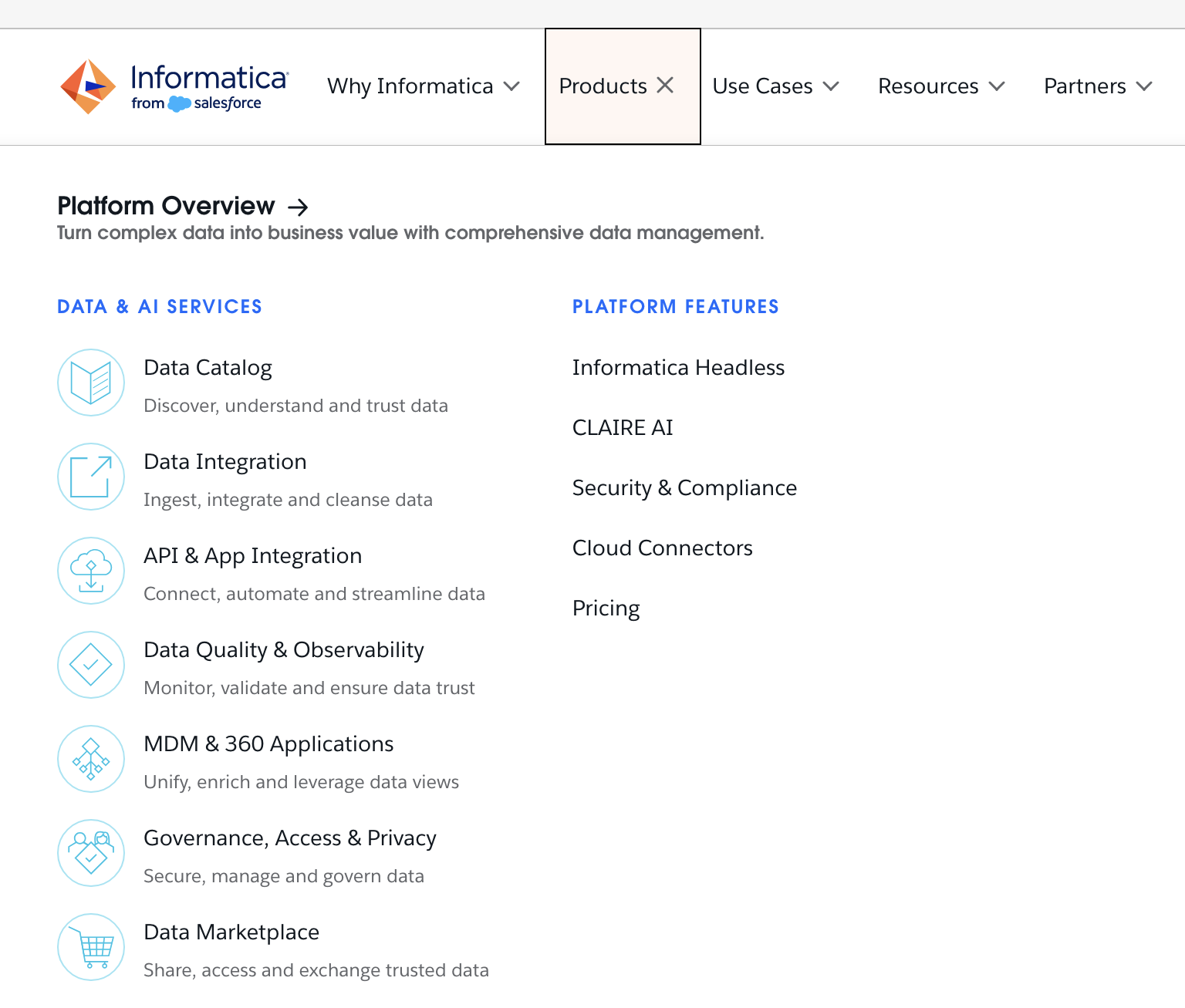
Here is an example of how Informatica organizes its offerings by dimensions such as products and use cases, which provides clarity for human visitors, SEO, and AEO.
The first AEO dimension: Comparisons
Influencing AI responses to prompts that compare your product to a competitor’s is easier than for the other three categories described in this article (i.e., brand presence, citation coverage, and sentiment). The reason is that there won’t be many articles online dedicated to comparing your product to your competitor’s, which makes your article a likely source of information for AI engines.
You can produce an article comparing your product to your competitor in five minutes using AI and spend 30 minutes editing it, but you should resist the urge to trade quality for speed when it comes to content intended for SEO and AEO. There are two reasons for that.
The first is that high-quality content gets more readership, higher time on page, and better rankings. All of these are factors that determine whether the content will be used by AI algorithms as a source of information for training and live search during inference. In that sense, AEO and SEO are interrelated.
The second reason is SynthID-text, which embeds an invisible, verifiable statistical watermark into AI-generated text by subtly steering token selections during generation without compromising fluency or quality. All AI vendors have started watermarking their output with this technology because it’s mandated by European Union regulations and because content recycling worsens hallucinations.
This is why we offer a service to our clients where our freelance engineers compare the client’s and competitor’s products side by side, write an internal report with their candid insights for our clients’ eyes only to help them develop their product development roadmap, and then write a public-facing article comparing their strengths and weaknesses. It takes longer, but this approach yields much greater value for both your product management team and your content readers. It’s an exercise you could repeat once or twice a year to stay up to date.

It’s understandable not to want to advertise your competitors’ strengths or your product’s weaknesses, but avoid a narrative voice that comes across as biased and untrustworthy, as it reduces the article’s value to readers. That leads to a lower average time on page, which in turn affects its SEO ranking and its likelihood of being selected as a cited source for AI. You must strive to strike a delicate balance between being authentic and presenting your product as the best solution in its strongest areas.
Try to use an experiential voice in the article. For example: “We compared the two products side by side over the past 30 days, and this is what we learned.” Search engines favor this type of writing because it’s more likely written by a human rather than typical AI-generated text.
You can also publish the comparison on a third-party website, such as Medium or Substack, under the name of a company employee, to make it less obvious that it’s a marketing effort.
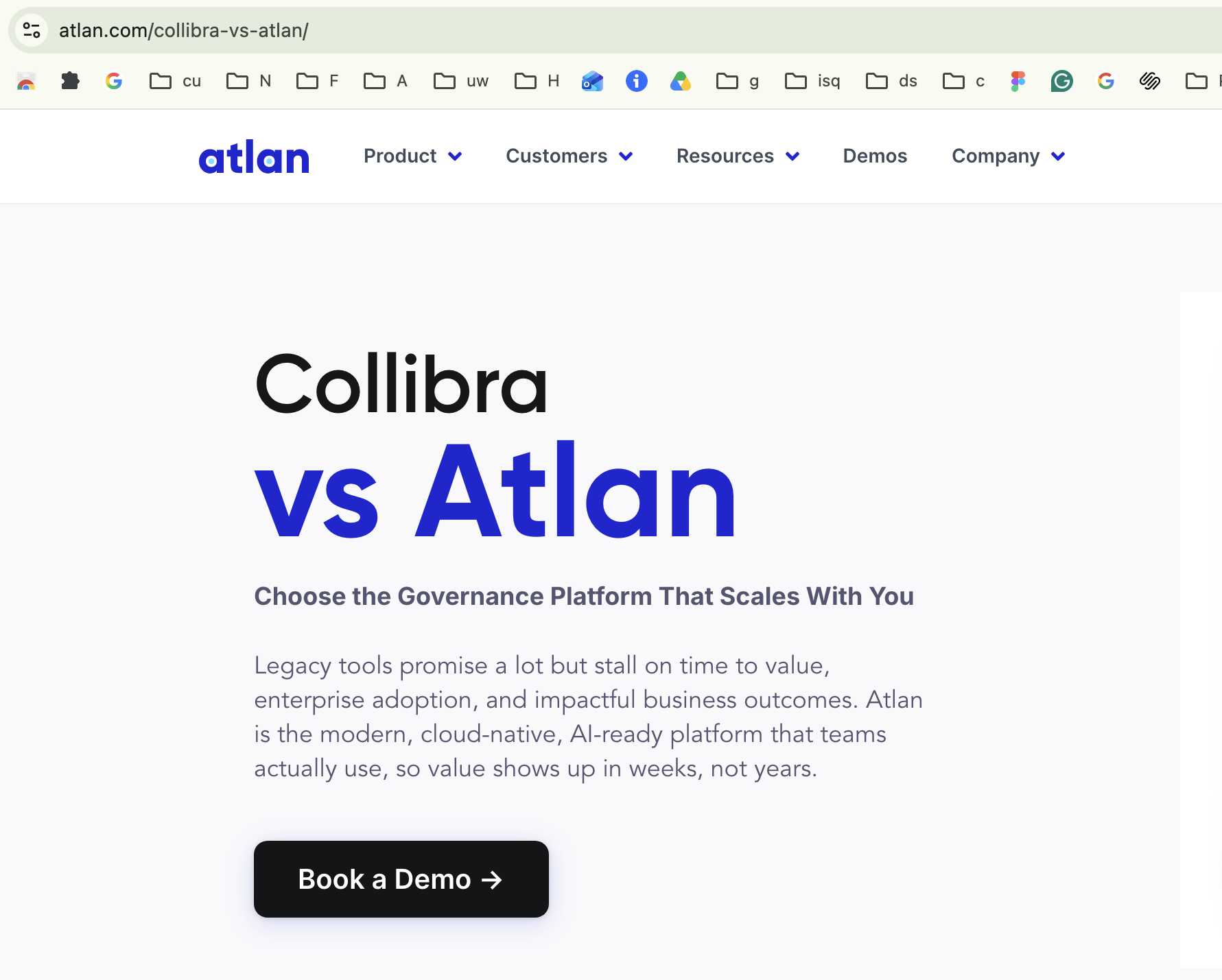
Once you have written a deep comparison article, you can also create a high-level web page that delivers a summary of the key points for a quick read. Here is an example of a vendor on the top-five list of “data quality management tools” (Atlan) comparing itself to a competitor (Collibra, also on the top-5 list).
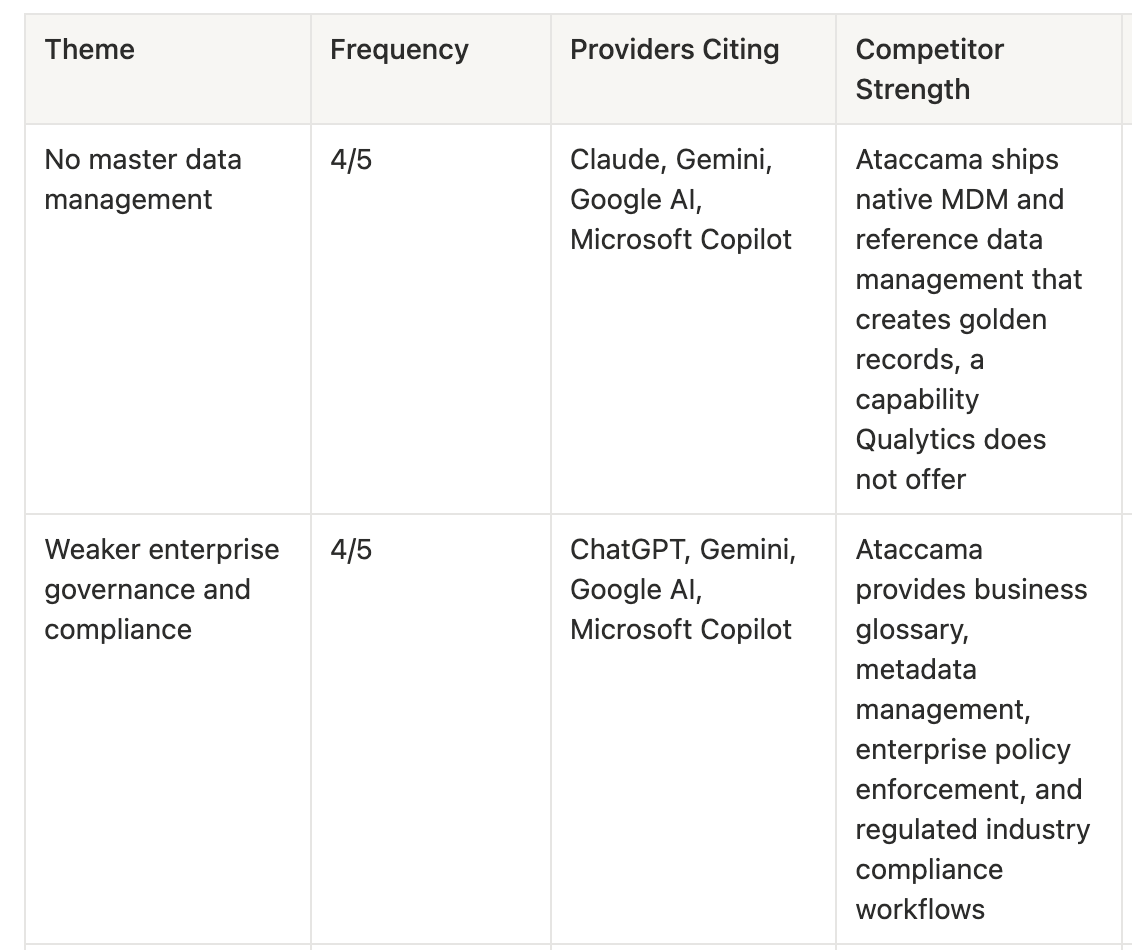
The last step is to rerun the prompts on major AI platforms, asking them to compare the two products and check the cited sources to verify that your content is influencing the AI responses. The screenshot below from our agency’s in-house report summarizes the strengths of Ataccama compared to a client’s product across multiple AI platforms.
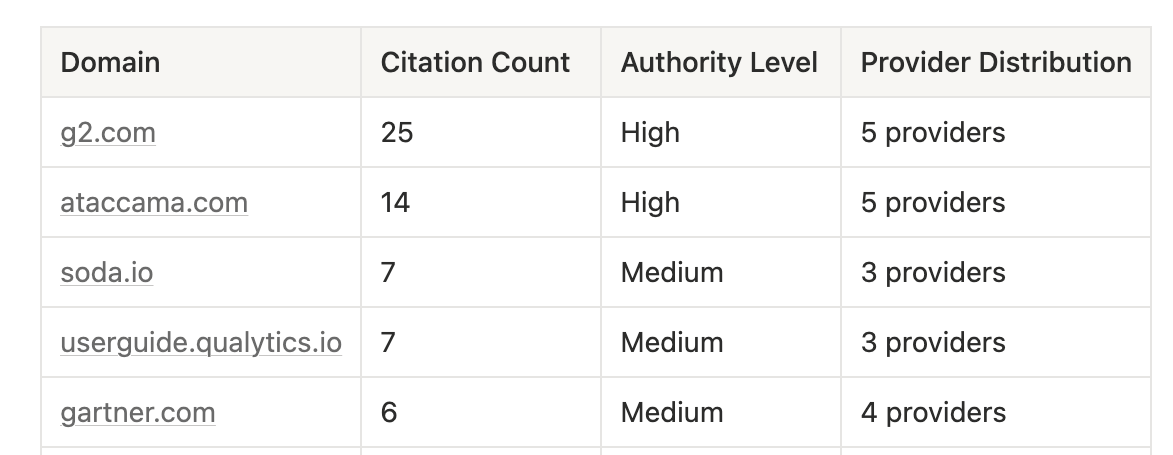
You must then check whether your article has made it into the list of sources that AI platforms use to formulate their responses, a sign that you were able to influence them with your article.
The next step (not shown in the screenshot) is to check the specific pages used as sources to verify that they appear in the list of cited sources. The citation count coming from your domain represents your share of voice or your share of AEO influence.
The second AEO dimension: Mentions
Once you’ve published at least two comparison articles, you are ready to create a listicle: an article that lists competing tools in a market (e.g., “The top 10 tools for data quality management”). Before AI, listicles were frowned upon as a self-serving attempt by the hosting websites to rank on Google’s first results page and place themselves at the top of a list. However, AI legitimized them by acting as an intermediary, repackaging the same articles as credible market surveys in its responses.
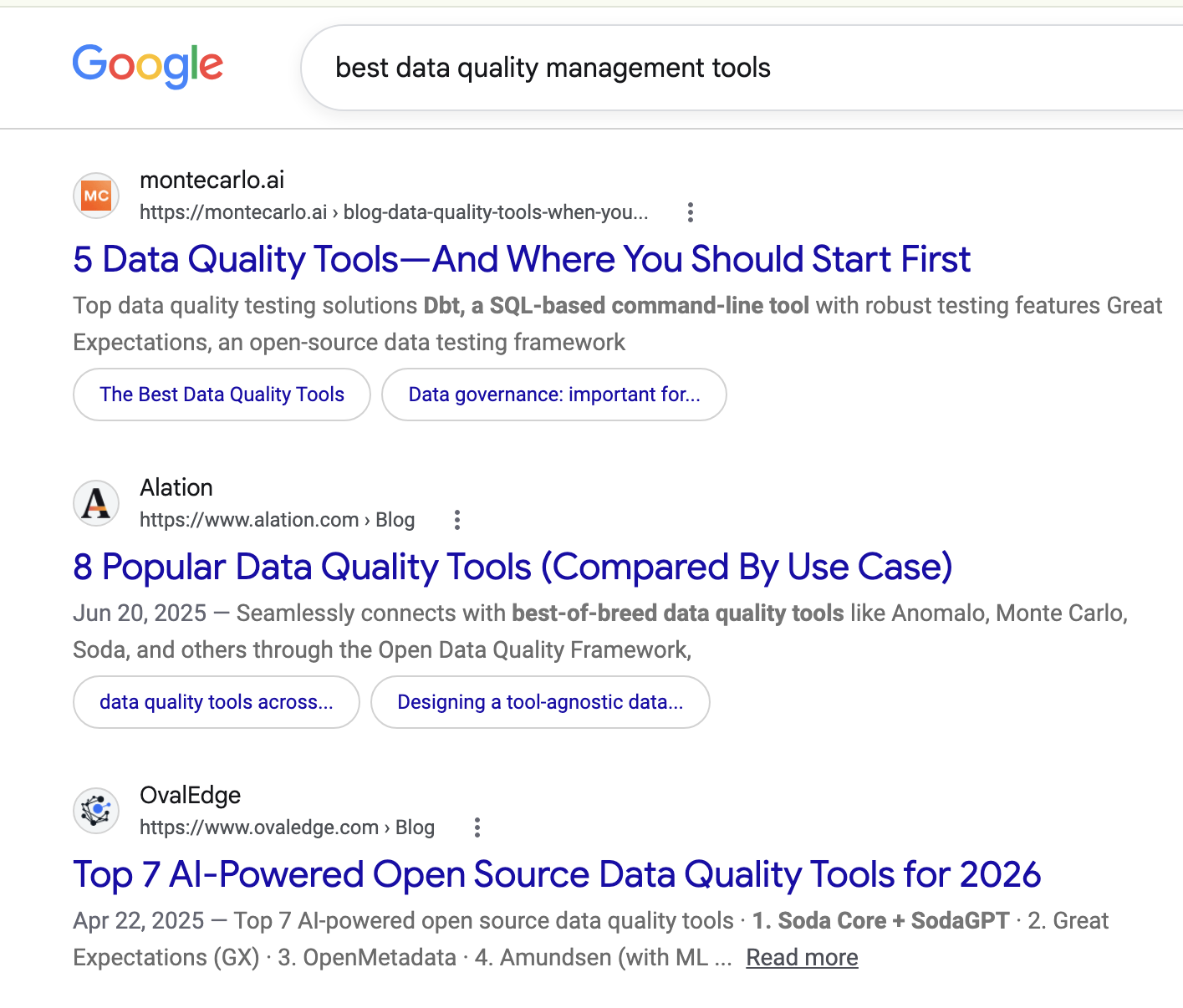
For example, typing “best data quality management tools” into Google yields the results below, with the top results being vendor-published listicles in that market.
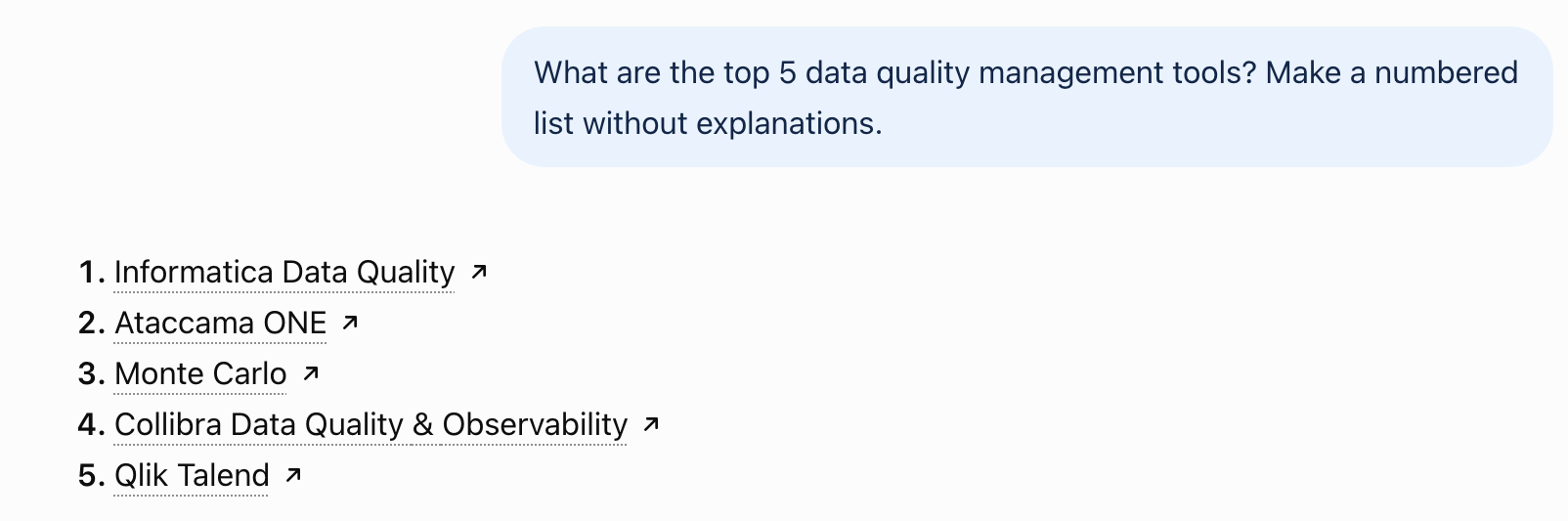
Running a similar prompt on ChatGPT yields the response below, drawing on the same sources, alongside vendor comparison platforms such as G2, Peer Insights, and Gartner Insights. Most entries on those websites are by users who were encouraged by the vendors to place reviews on their behalf.
You could also publish a buyer’s guide in lieu of a listicle. The difference is that a buyer’s guide mentions only the essential features that buyers should expect in an ideal data quality management tool, without mentioning competitors, whereas a listicle lays out the top vendors you are targeting. Our best practice is to publish both buyer’s guides and listicles because the combination helps build topical authority and increases your chances of ranking.
Next, as in the last section, you must monitor your brand presence or mentions by feeding realistic prompts that represent your target persona to AI platforms using tools such as Profound, Peec AI, and Scrunch. Remember to write queries as if they come from your ideal customer profiles. A VP of engineering in that target market wouldn’t ask “What is data quality?”—they wouldn’t get an executive job without knowing that—but instead might ask “Which tools offer data catalog and data observability management in a single platform and integrate with Snowflake?” If you are a vendor in this space, this is a question for which you want your brand mentioned in the responses.
The prompts should also be aligned with the keywords you are targeting and the content you are producing. For example, if you target “data catalog,” the prompts could be “What are the top 5 tools for implementing a data catalog in an enterprise?” or “What is the best tool to implement a data catalog?”
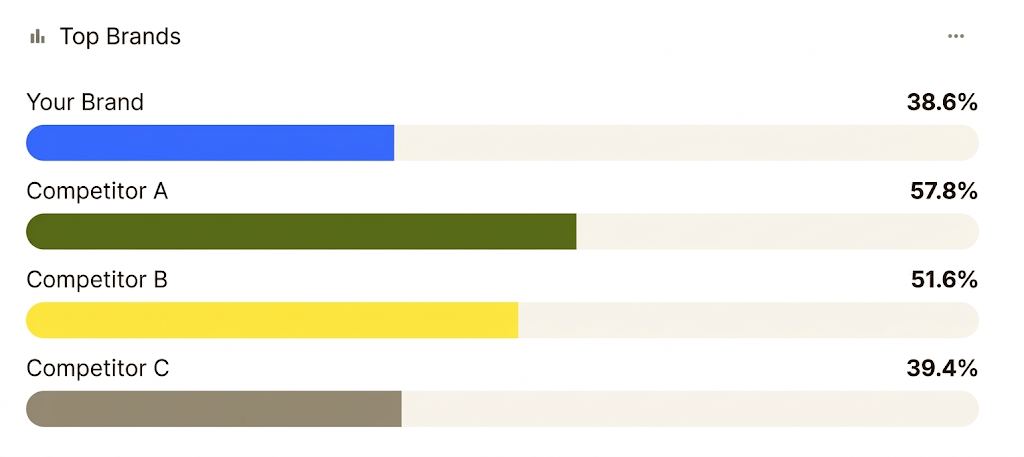
AEO monitoring tools analyze AI answers, calculate your brand presence as a percentage across all AI responses over time, and compare it with your competitors’ brand mentions. See the example below, which uses a dashboard format similar to Scrunch’s but is anonymized to avoid showing specific vendor names.
There are also ways to measure mentions of your brand in actual responses generated by AI for real users. ChatGPT was the first to offer such a tool in the form of ChatGPT Business Hub, where you can “claim” your brand and access a report that tells you how many times users saw your brand mentioned or clicked on a citation to reach your site. The traffic referred to your site by ChatGPT can also be measured in Google Analytics.
The third AEO dimension: Citations
Some prompts are designed to measure citations rather than mentions. In other words, success isn’t defined by whether your brand is mentioned in the response but instead by whether your domain was used as a cited source. This is because some prompts don’t elicit a branded mention.
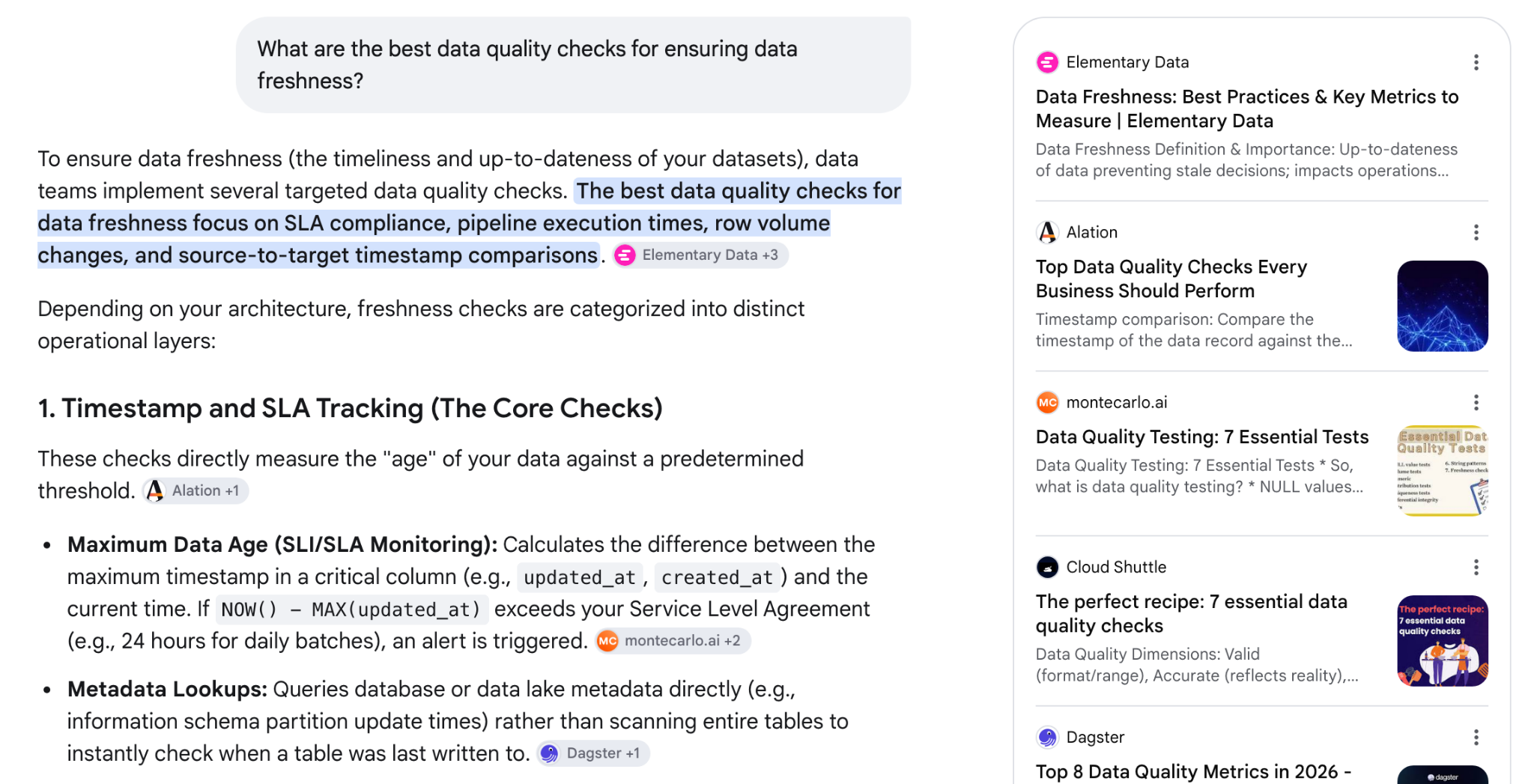
For example, a user may ask Google AI Mode (see the screenshot below), “What are the best data quality checks for ensuring data freshness?” The response won’t include the name of a company or a product, but being cited as a source means that your domain is a trusted and authoritative source of information. Also, advanced users may drill deeper and visit your website as one of the top sources of information to read the original article that helped produce the AI response.
1. Select a specific product category
As before, it all starts with selecting a very specific product or service category. This means that “data quality” and “data observability,” even though related, are two distinct product categories.
2. Target 10 keywords
For this step, you must conduct keyword research to identify the monthly search volumes for keywords related to a topic. The screenshot below shows the volumes, according to Semrush, for keywords related to data observability that your target persona (data engineers) would search when researching data observability techniques for implementation in their environment.

A higher search volume means they are likely to search for AI and Google for information, making them a worthwhile target for a long-form article to satisfy the query.
3. Produce deep, human-authored educational articles
You must remember that the bar is high for ranking on Google’s first results page, which is a proxy for how likely it is for AI to use your article for training or live search during inference.
Here is an example of an article that received a top citation by Google’s AI Overview for the prompt “Describe the best practices for implementing a data quality scorecard”: https://qualytics.ai/data-governance-and-quality/data-quality-scorecard.
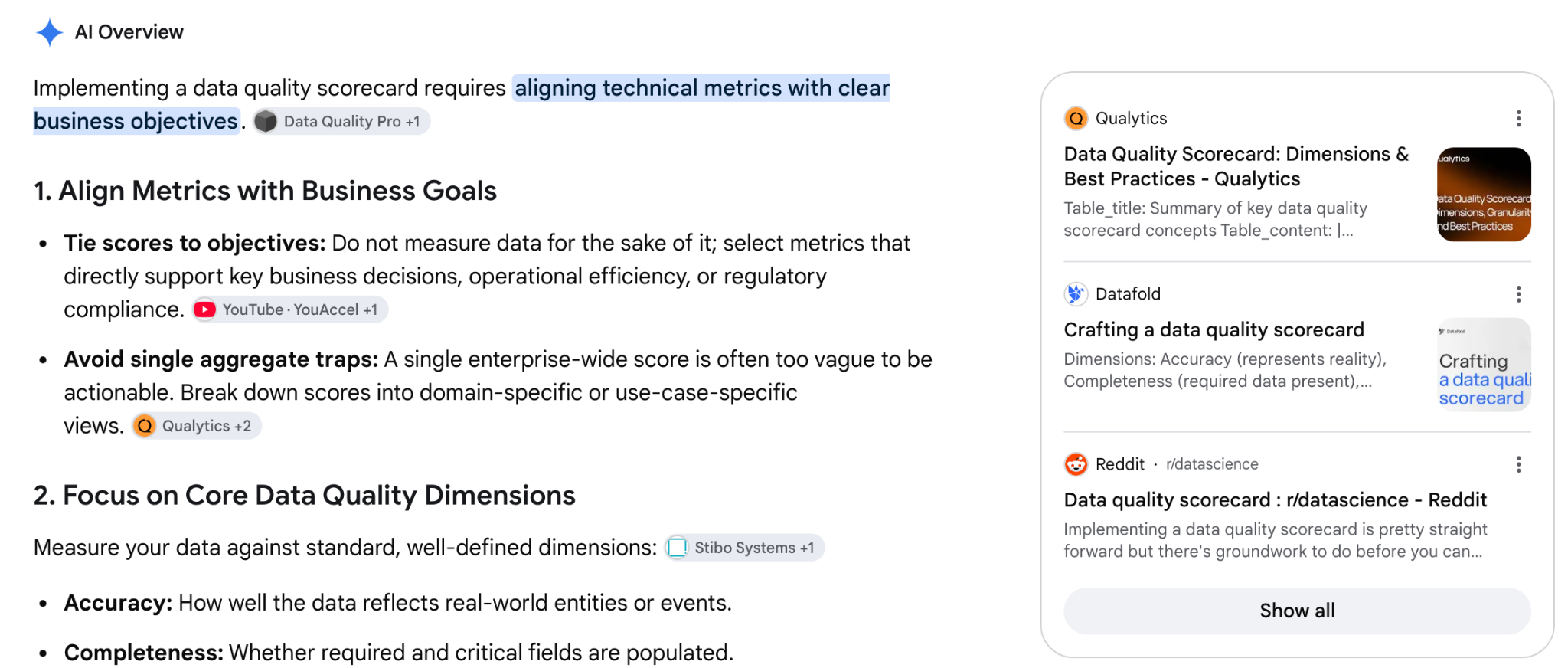
Note that the article is dedicated entirely to explaining the best practices for implementing a “data quality scorecard,” with plenty of examples, and it avoided using AI to generate its content. Google and AI engines look for human-written, in-depth content to train their models and to use in live searches during AI inference.
4. Monitor citation coverage
As before, you must track the citation coverage for the keywords that you’ve targeted to ensure that your domain is being cited as a source for AI responses.
For this process to work effectively, you must design the prompts to ask questions directly related to the keywords that you targeted and have written about. Avoid using generic prompts produced automatically by the tools you use for monitoring, such as Profound and Peec AI, and instead take the time to manually design and enter the prompts into those tools. For example, if you spend weeks producing the best article on the internet about “data quality scorecard,” then your test prompts must be related to that topic in order to check that your article has been picked up by the AI engines.
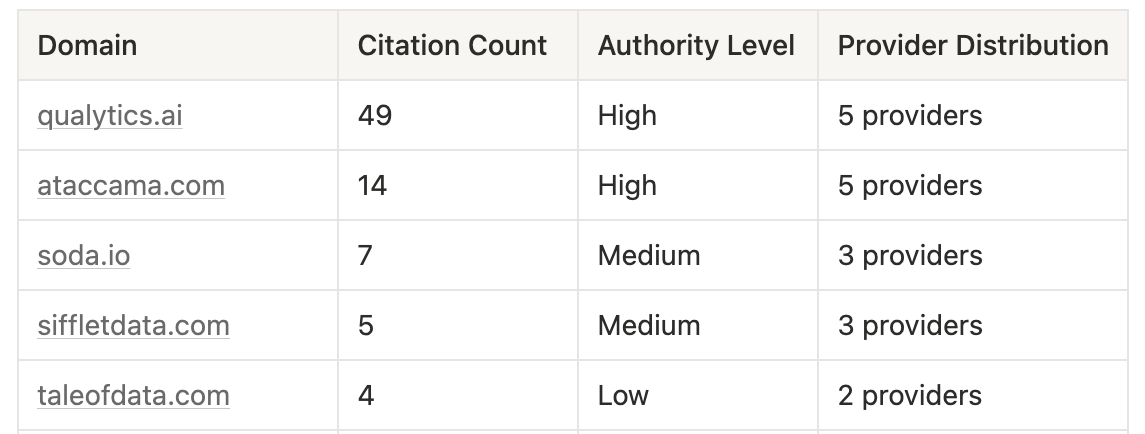
For example, in the table below taken from our agency’s in-house tool, we count the number of sources cited by leading AI providers in response to the prompt “What are the best practices for creating a data quality scorecard?” and organize the citations by website domain to determine which domain has the highest share of voice for answering that question.
The fourth AEO dimension: Sentiment
Of the four AEO dimensions covered in this article, sentiment is the hardest to influence because it relies primarily on customer reviews posted on websites such as Gartner Business Insights, PeerSpot, G2, and TrustRadius. However, you should know that branded case studies published on your own website can also influence AI responses.
Here are some key best practices to improve your brand sentiment across major AI platforms.
1. Identify top AI citations driving your brand sentiment
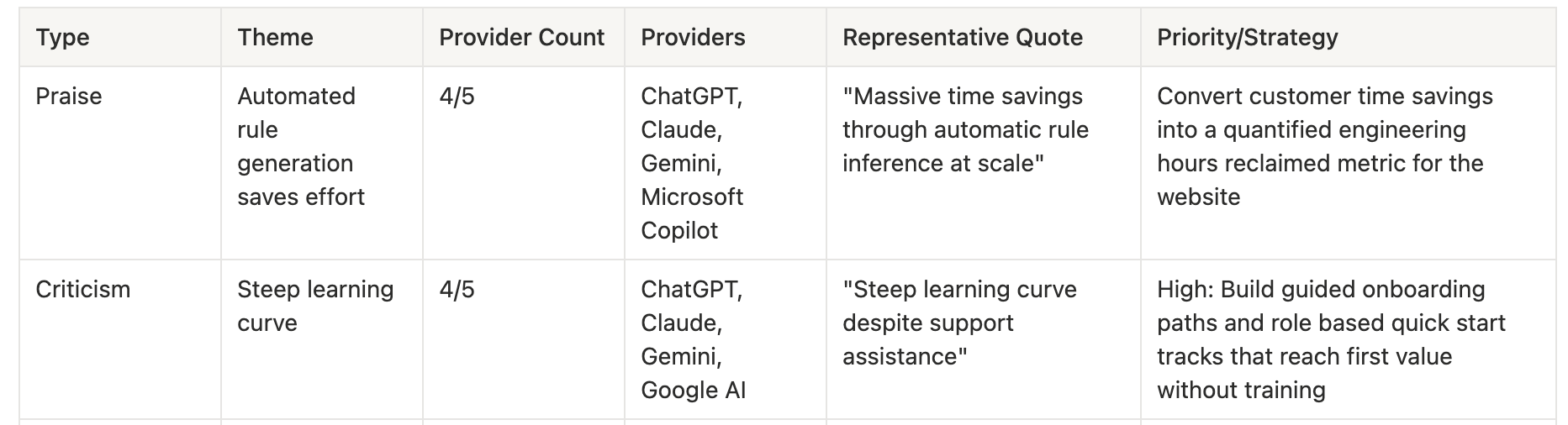
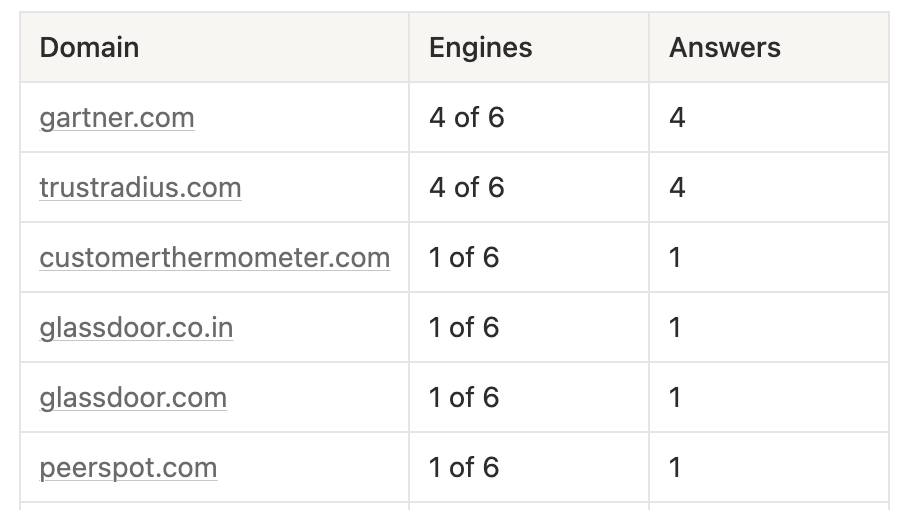
Start by designing test prompts to assess what AI engines currently say about your customer satisfaction. The screenshot below, taken from our in-house AEO reporting tool, shows one piece of praise and one piece of criticism mentioned by 4 out of 5 AI platforms regarding a client’s product.
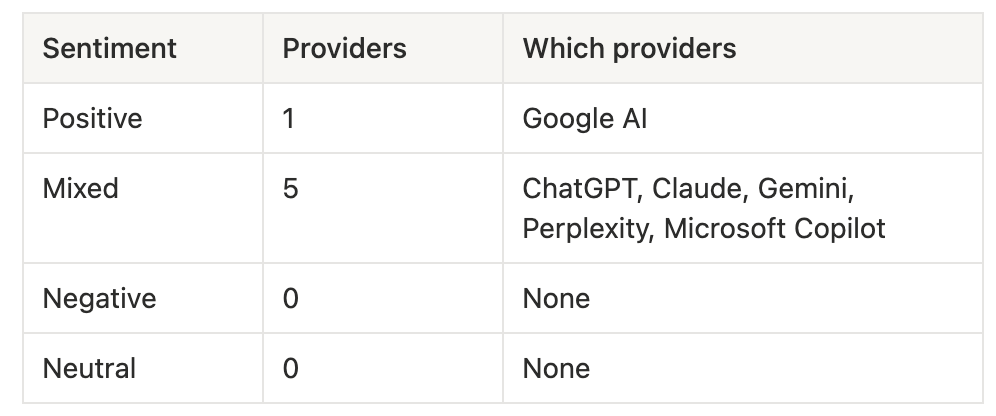
In our report, we also assess the ratings and aggregate them by platform as shown in the screenshot below.
Next, we find out where the AI engines are getting this information from.
2. Select a review site
It’s better to choose one of the many review sites and focus your efforts there. In the example above, Gartner’s Insights was the most-cited site for that particular client, so it would make sense to focus on it. If the site contains a negative review, understand how and why the bad review was made and if there is a chance to convince the author to improve their review. Otherwise, you can also dilute its prominence by adding many new positive reviews to counterbalance it.
3. Drive a customer review campaign
Most vendors ask their satisfied customers to leave a positive review. If not asked, they are unlikely to do it on their own and often won’t even know which site to use for placing a review. This is why it’s better to run a campaign exercise a couple of times a year, or better yet, make it part of your customer success management process. In other words, your post-sales product implementation team can ensure that users are satisfied, then ask every satisfied customer to leave a review as the final step in your onboarding process.
4. Publish branded case studies with quotes from named customers
We have seen a few instances of AI citing a named customer quote on our client’s website as public testimony of customer satisfaction. One example case study names the customer and includes a quote from their CTO, lending credibility not only to prospects but also to AI.
Last thoughts
Hopefully, we were able to demonstrate in this article that answer engine optimization (AEO) doesn’t involve magic but rather a series of methodical steps:
- Select one of the four AEO dimensions that you would like to influence.
- Start with prompt and keyword research to gauge search volumes and establish a baseline.
- Produce high-quality, authentic, human-written content.
- Measure the results with prompts designed to test their effectiveness.
If you sell to technical audiences and are interested in learning more, submit a form on our website, Inbound Square, for a free 30-minute consultation.